
How Do Small Businesses Actually Get Cited by AI Search Engines?

Many small business owners wonder if earning an AI citation is truly difficult. How can you make sure your business is recognized by Google AI Overviews or by generative engines such as ChatGPT, Claude, and Perplexity?
Here is the most important insight: Even if your small business has found it difficult to reach page one on traditional Google, you still have a real chance to be cited today. AI search offers small businesses a new and fair opportunity, as long as you understand how these engines select their sources.
What is GEO? (And What Happens If You Stick to Traditional SEO?)
To succeed in AI search, let us first clarify some of the terms:
- Traditional SEO (Search Engine Optimization): The classic strategy of building website authority, targeting exact-match keywords (e.g., “best plumber in Chicago”), and getting backlinks so Google ranks your website link on page one.
- GEO (Generative Engine Optimization): The practice of structuring your content so AI models (ChatGPT, Perplexity, Claude, Google AI Overviews) easily extract your information, summarize it, and cite your brand with a direct link inside their answer.
Let us consider what happens if you continue using only traditional methods.
Imagine a customer asks an AI: “How much should a small business spend on a website redesign?”
- The Traditional SEO Approach: You write a 3,000-word blog post filled with generic introductory fluff (“In today’s fast-paced digital landscape, having a modern website is paramount…”). You bury the actual pricing deep on page four of your article.
- AI search engines process information quickly. If your article does not provide a clear and direct answer near the top, the AI will likely skip over it.
- The risk of relying only on traditional methods is that your business may not be seen. Recent studies show that more than 60% of Google searches now end without a click. When AI Overviews provide instant answers at the top of the page, most users do not scroll down to the usual search results. If your business is not cited in that summary, you miss out on valuable traffic.
How AI Engines Find Answers
Let us take a closer look at how AI search engines find answers, step by step:
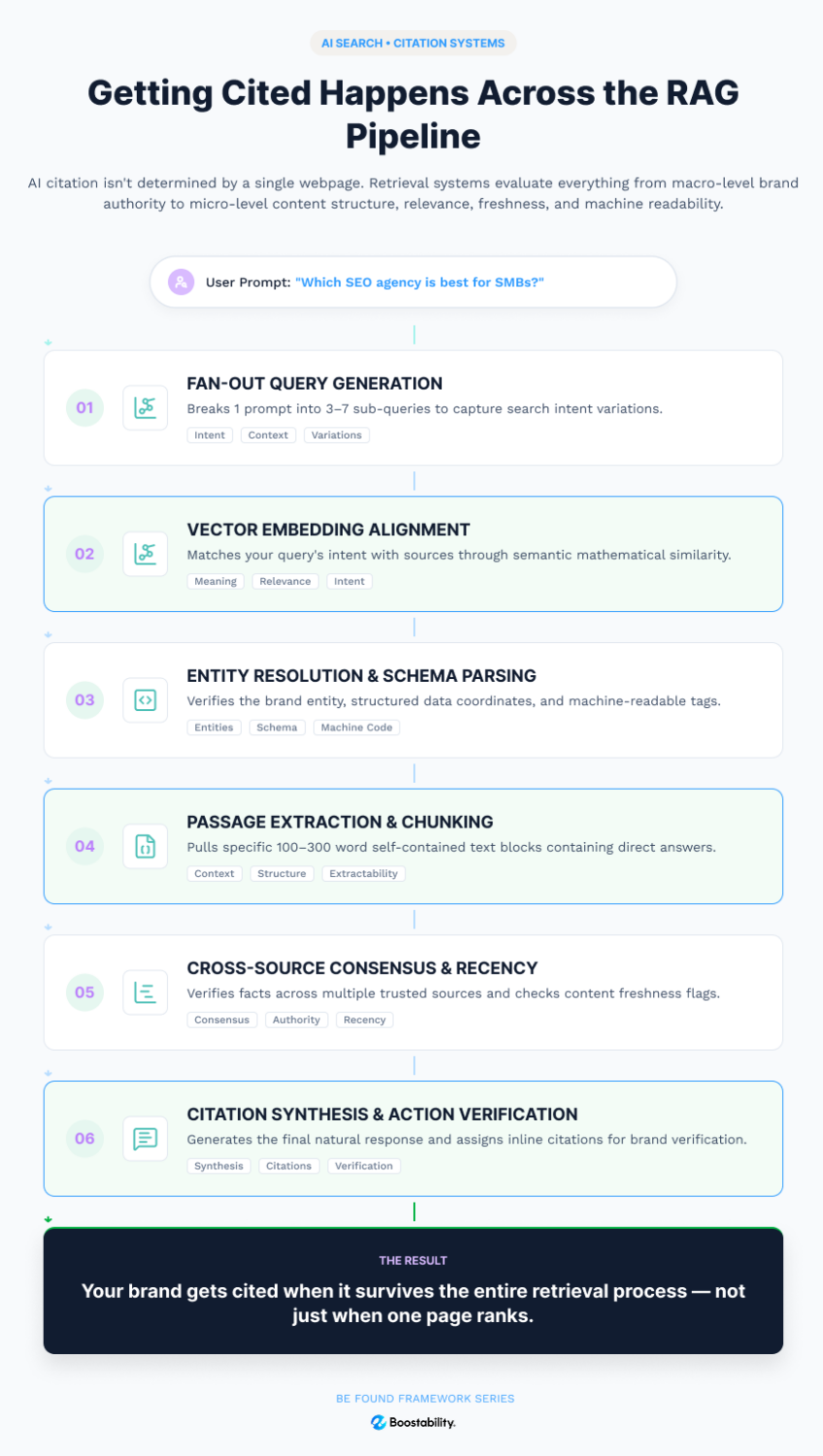
Step-by-Step Breakdown with Real-World Scenarios
A. “Fan-Out Query Generation” (Question Splitting)
- What it means: When someone types a complex question into an AI search engine, the AI automatically splits that prompt into 3 to 7 smaller sub-questions behind the scenes.
- Scenario: If a user asks: “What is the best CRM for a 5-person consulting agency on a low budget?”, the AI generates sub-searches like:
- “CRM pricing under $30/month”
- “Top lightweight CRMs for consulting agencies”
- “HubSpot vs. Pipedrive small business reviews”
- Why does this matter? Your small business does not need to compete for the biggest keywords. If your website provides a clear answer to one of these specific questions, you have a strong chance to be cited.
B. “Vector Embedding Alignment” (Digital Matching)
- What it means: Instead of just looking for matching keywords, AI translates both the user’s question and your web text into mathematical “concept maps” (vectors) to see if they mean the same thing.
- Scenario: A user asks, “How do I fix a leaky kitchen sink?” Even if your article uses the phrase “repairing a dripping faucet,” the AI recognizes these mean the same concept semantically and selects your text.
C. “Entity Resolution & Schema Parsing” (Verification Code)
- What it means: AI search engines look at code snippets on your site (Schema Markup) and cross-reference your business name against trusted databases to verify that you are a real, legitimate brand.
- Scenario: When an AI reads your page, FAQPage and Article schema markup tell the crawler, “Here is an exact question, and here is our expert answer.” This allows the AI to parse your facts instantly without guessing.
D. “Passage Extraction & Chunking” (Plowing Through Text)
- What it means: AI search models do not cite full articles. They break your page into short “chunks” (100–300 words). If a chunk contains a complete, self-contained answer, it gets extracted for citation.
E. “Cross-Source Consensus” (Fact Checking)
- What it means: AI models hate hallucinating false information. Before citing your claim, the AI cross-references it across other websites, review forums (like Reddit, Quora, or G2), and public directories.
- Scenario: If your website claims “Our coffee shop uses 100% organic fair-trade beans,” and local news blogs, Yelp reviews, or social pages mention the same detail, the AI gains high confidence to cite you as a trusted source.
F. “Citation Synthesis & Action Verification” (Generating the Link)
- What it means: The AI rewrites the extracted facts into a conversational answer and attaches a direct clickable source citation.
What the Data Says: Proof from Leading Studies
You do not have to guess what works. Researchers have already studied which types of content are most likely to be cited.
Study 1: The Princeton University GEO Study
Researchers from Princeton, Georgia Tech, and the Allen Institute published the foundational benchmark study on Generative Engine Optimization (Aggarwal et al., arXiv:2311.09735). They tested different content modifications across thousands of queries and found:
- Inline Source Citations (+40% Visibility Lift): Pages that explicitly cite authoritative primary sources or industry studies within their text see the highest increase in AI citations.
- Statistical Density (+37% Visibility Lift): Replacing generic claims (“we are very fast”) with hard metrics (“our average delivery time is 24 hours”) dramatically increases citation rates.
- Expert Quotes (+30% Lift): Including attributed quotes from recognized industry figures signals high credibility to LLMs.
Study 2: Cyrus Shepard’s Zyppy AI Ranking Factors
In an analysis of 54 AI search experiments and case studies, SEO researcher Cyrus Shepard published the Zyppy AI Citation Ranking Factors. His analysis revealed:
- Answer Near the Top: Earning an AI citation heavily relies on putting your core answer within the first 200 words of a page.
- Traditional Search Synergy: According to data from Ahrefs cited in the study, 38% of Google AI Overview citations come from pages already ranking in the top 10 organic search results. Earning AI citations builds directly on good baseline SEO.
Study 3: The AirOps “Answers to Actions” Study
A study by AirOps, titled AI Search Is Moving From Answers To Actions, tested 1,350 queries across 50 companies using AI models like Claude, Codex, and Cursor.
- The Finding: In 52% of comparisons, simply changing the prompt from a general question (“Which tool should we choose?”) to an action-oriented setup prompt (“Which tool has the clearest setup path?”) changed which company finished first.
- The lesson for small businesses is clear: AI search now helps users take action, not just answer questions. Even large competitors have lost their lead when users look for practical, step-by-step guides. This gives well-organized small businesses a real opportunity to stand out.
Real-World Example: Transforming Content for AI Citations
Let us see how a small business can turn a typical blog paragraph into content that AI search engines are more likely to cite.
Before: Generic & Uncitable (Traditional Fluff)
Why Email Marketing Matters for Small Businesses
In today’s fast-paced digital world, email marketing is a very effective tool for businesses to reach their customers. It helps you build strong relationships and increase sales over time. Many experts agree that email has a higher return on investment than social media marketing. If you want your business to grow, you should build an email list today.
- Why AI Skips This: Zero numbers, generic fluff, no named sources, and no unique data.
After: Restructured for High AI Citation (GEO-Optimized)
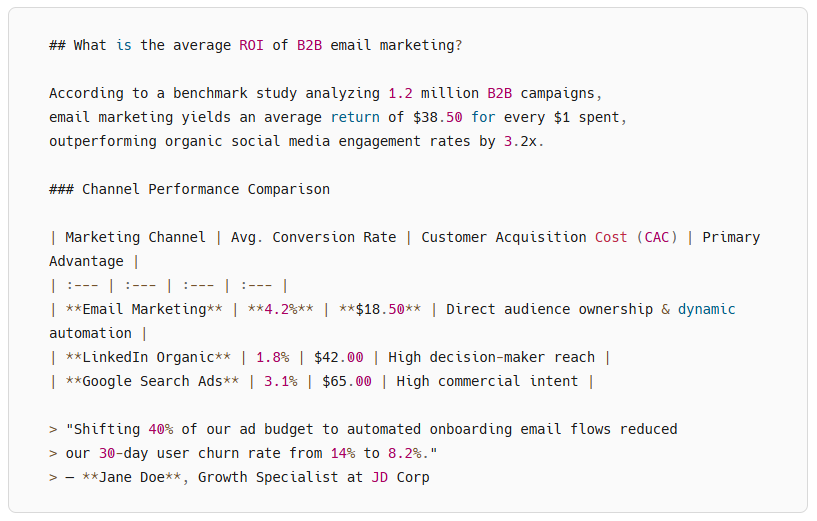
Why AI Cites This: It leads with a 30-word direct answer, includes exact metrics ($38.50 ROI, 3.2x lift), uses a clean Markdown table, and cites an expert quote with a named entity (Sarah Jenkins at TechCorp).
How Boostability Wins with the Be Found Framework (BFF)
At Boostability, we don’t guess what search engines want—we build strategies grounded in over a decade of hands-on small business SEO data. To help our clients dominate both traditional search and AI engine summaries, we created our proprietary Be Found Framework (BFF).
The BFF model optimizes your website across three overlapping visibility layers:
| BFF Visibility Layer | Strategic Focus | The Ultimate AI Search Goal |
|
1. Classic & Local SEO
|
Clean technical hygiene, mobile speed, Google Business Profile, and natural link building. | Ensuring search bots and AI scrapers can crawl and index your site without technical errors. |
|
2. AEO (Answer Engine Optimization)
|
Formatting content using our 40-Word Definition Rule directly under question headers.
|
Becoming the absolute fastest, most concise answer for high-intent user questions and voice search. |
|
3. GEO (Generative Engine Optimization)
|
Hard data hardening (data tables), author sameAs schema, and primary information gain.
|
Proving deep brand context so LLMs treat your site as an undeniable, citable authority. |
Put It Into Practice: The 3-Step BFF Audit Workflow.
To see how the Be Found Framework transforms a page in the real world, here is how we audit and upgrade web content for maximum AI citations:
- Layer 1 Audit (Technical Baseline): Ensure the page loads in under 2.5 seconds, returns a clean 200 OK status, and uses logical H1/H2 heading tags so AI crawlers can index it effortlessly.
- Layer 2 Audit (AEO Alignment): Rephrase subheadings into natural conversational questions (e.g., “How Much Does Local SEO Cost?”) and apply our 40-Word Definition Rule—placing a concise 30-to-40-word answer directly under the header.
- Layer 3 Audit (GEO & Data Hardening): Add statistical density (at least 1 metric per 150 words), convert descriptive comparisons into structured Markdown tables, and embed FAQPage JSON-LD schema markup into the page code.
By following this three-step audit, you can turn a general paragraph into a well-structured and informative resource that Google AI Overviews, ChatGPT, and Perplexity can easily recognize and cite.
Ready to Be Found in the Age of AI Search?
Earning citations in Google AI Overviews, ChatGPT, and Perplexity is not a matter of luck. As search technology continues to evolve, it is important to rely on proven strategies and human expertise that align your content with both real user needs and the way AI models choose their sources.
Whether you are a small business looking to outrank local competitors or an agency seeking a trusted white-label partner, Boostability is here to help you get found.
Primary Research & Reference Links
- Princeton University GEO Study: Aggarwal et al. (2024), GEO: Generative Engine Optimization (ACM SIGKDD 2024).
- AirOps Action Study: Alex Halliday (2026), AI Search Is Moving From Answers To Actions.
- Zyppy Citation Analysis: Cyrus Shepard (2026), 23 Factors That Actually Get Your Content Cited by AI Search Engines.
- Wellows AI Search Study: Wellows Research (2025/2026), SEO for AI Search: Strategies That Get Results.
- Boostability Be Found Framework: Boostability (2026), Beyond the Blue Links: How Our “Be Found Framework” Navigates the New Search Playbook.
Posted in Thought Leadership
