

The search engine results page (SERP) is no longer a static list of ten blue links. If you have looked at a search screen recently, you know that traditional organic real estate has been completely compressed. Between Google’s AI Overviews (AIO) now appearing on a massive chunk of search queries and conversational engines like Perplexity or ChatGPT picking up massive user traction, the goals of optimization have structurally changed.
At Boostability, we’ve always believed in making high-growth digital visibility accessible to every business. To win traffic now, you cannot rely on the old playbook alone. You have to optimize across multiple newly dominant digital layers.
To solve this exact challenge, we developed our proprietary Be Found Framework (BFF). The BFF methodology ensures your business establishes an unmistakable digital footprint, transforming your content into a highly authoritative asset that users trust and AI engines actively cite.
Navigating the Multi-Layered Search Reality
Within the Be Found Framework (BFF), modern search visibility is broken down into three distinct, overlapping visibility layers of the exact same content asset. Rather than treating these as conflicting tactics, our framework synthesizes them into a singular roadmap:
| BFF Core Layer | The Strategic Focus | The Ultimate Goal |
|---|---|---|
| Traditional SEO | Technical hygiene, site architecture, core web performance, and link-based crawlability. | Ensuring your code foundation is clean enough for search bots and AI scrapers to read your pages efficiently. |
| AEO (Answer Engine Optimization) | Structuring and formatting copy to target instant answers, featured snippets, and voice search. | Becoming the absolute fastest, most concise answer to an isolated, high-intent user question. |
| GEO (Generative Engine Optimization) | Enhancing content authority, embedding original data, and proving deep context. | Getting your brand named, summarized, and actively cited within an AI-generated synthesis response. |
Phase 1 of the BFF: AEO and “Inline Snippet Hardening”
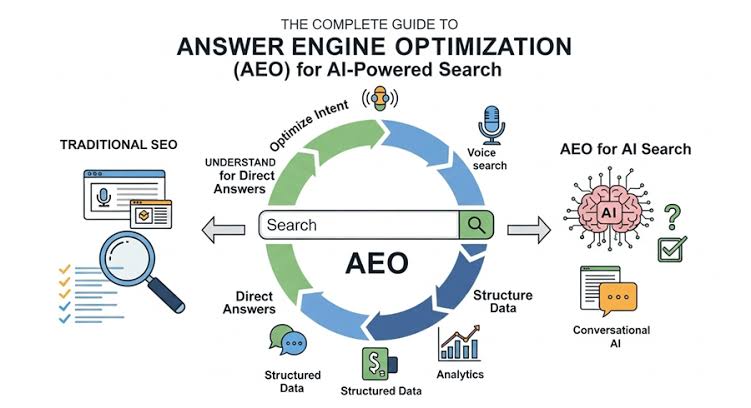
Answer Engine Optimization isn’t a brand-new concept, but its execution has hardened. Historically, AEO meant scattering simple Q&As across your blog to catch a quick featured snippet. Today, answer engines are pulling text fragments directly to resolve searches right on the results page—leading to massive zero-click environments.
The Core Update:
Google recently dropped native FAQ rich results from standard search layouts, but keeping FAQ schema remains a non-negotiable step within our framework. Why? Because conversational search engines heavily crawl, extract, and match these structured hidden data fields to ground their instant speech or text answers.
How We Execute This in the BFF:
- The 40-Word Definition Rule: Do not bury your conclusions. Lead every major educational section with a crisp, direct answer (roughly 40–60 words) immediately beneath your question-based H2 or H3 headers. Avoid using vague headers like “A Few Thoughts on This”—instead use explicit phrasing like “How to Reduce Database Webhook Latency.”
- Eliminate Ambiguous Pronoun Chunks: AI bots pull text blocks (chunks) out of context to feed an answer. If your paragraph says, “Our software addresses this issue by automating it,” an AI engine cannot easily identify what “it” or “this” refers to. The Be Found Framework mandates explicit named entities: “The [Brand Name] pipeline resolves database latency by automating…”
BFF in Action: Before & After
Imagine a local B2B commercial HVAC company trying to be found for the query: “How often should commercial AC filters be replaced?”
Old SEO Approach: Write a long paragraph talking about the history of air filters, the changing seasons, and eventually mention that it depends on the building size, burying the timeline deep in the copy.
The BFF Approach:
H2: How Often to Replace Commercial AC Filters
“Commercial AC filters should be replaced every 3 to 6 months. High-occupancy corporate buildings or industrial spaces handling debris require filter swaps every 3 months, while smaller retail storefronts can extend use to 6 months. Timely replacement prevents system strain and maintains indoor air quality.”
Phase 2 of the BFF: GEO and the Information Gain Imperative
Generative Engine Optimization is where the most aggressive shift is happening. Large Language Models (LLMs) do not look at content the way traditional PageRank does. They evaluate linguistic patterns, factual concentration, and domain authority signals.
The Core Update:
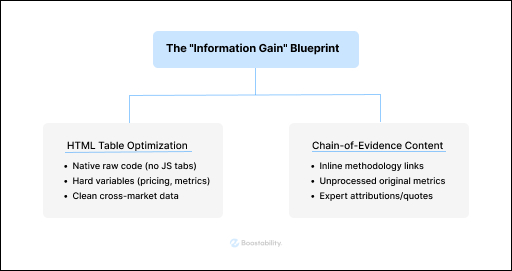
Recent search visibility benchmarks have revealed a major structural decoupling: nearly 47% of AI citations come from websites that do not even rank in Google’s top 5 organic results for that exact query. AI models do not just parrot the highest-ranking link; they crawl for unique text assets that add completely fresh data to their response loop—a concept known as Information Gain.
How We Execute This in the BFF:
- Hard Data Hardening: Academic research indicates that adding raw, well-structured data tables or authoritative statistics into your text can boost your AI citation frequency by over 40%. Our framework converts your comparisons, pricing structures, and variable matrices into clean, raw HTML tables instead of hiding them behind JavaScript toggle switches or interactive elements.
- Build Off-Site Entity Footprints: An AI model establishes brand trust by cross-referencing information across the entire web, not just your homepage. The Be Found Framework looks outward—scanning user-generated content spaces like Reddit, specialized trade forums, and third-party review platforms. If your brand lacks independent cross-platform discussions, AI engines will filter your business out of contextual recommendations.
Phase 3 of the BFF: Google Concedes Control to Publishers
The tension between AI-driven search models and content publishers reached a massive turning point recently. Following intense industry pressure regarding traffic declines, Google made its most significant search platform announcement since the expansion of AI Overviews.
Our Be Found Framework is built to adapt dynamically to these platform adjustments:
1. The Independent AI Opt-Out Toggle: Control Your Ingestion
Google is rolling out an independent toggle inside Google Search Console (GSC). Publishers can now officially opt out of having their content used to power or ground AI Overviews, AI Mode, and AI Discover features—completely independent of standard web results. If you choose to opt out, Google explicitly states your traditional search rankings will remain unaffected.
2. The Launch of Search Generative AI Reports: The End of Data Blindness
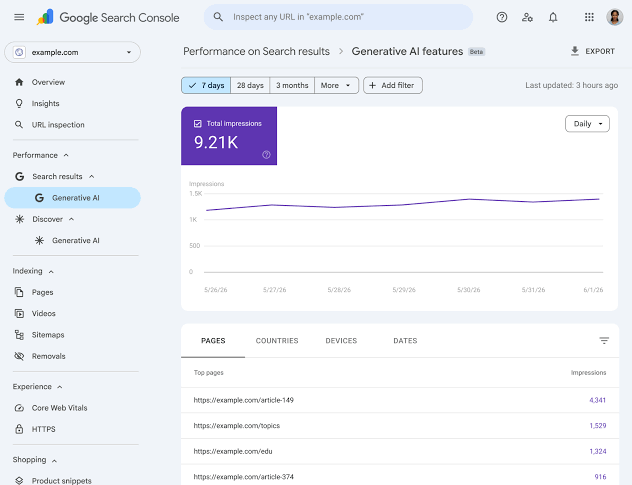
To encourage webmasters to stay opted-in, Google is launching dedicated Generative AI Performance Reports directly within GSC. Through the BFF lens, we utilize these reports to track exact impressions, monitor traffic patterns coming directly from AI summary citations, and identify precisely which pages are surfacing inside AI Mode across different countries.
3. Preferred Sources & Links Expansion: The Incentive To Stay
To combat rising traffic concerns, Google has expanded inline reference links and website previews inside AI layouts. They have also deployed a “Preferred Sources” feature, giving users the ability to manually tag trusted domains they want prioritized within their conversational summary feeds.
Future-Proofing with the Be Found Framework
To win the long-term game, your content framework needs to treat generative engines as critical consumers. The Be Found Framework (BFF) deploys three core workflows to achieve this:
A. The “Unique Data” Sprint
Commit to publishing proprietary data at least once per quarter. Conduct customer surveys, analyze anonymized platform data, or publish internal project case studies. AI engines aggressively hunt for novel statistical citations to justify their generative claims.
B. Implement Structured Entity Semantic Schema
Don’t just rely on basic article schema. The BFF implements advanced sameAs schema to link your brand and authors directly to verifiable third-party databases (like Crunchbase, LinkedIn profiles, or official industry directories). This builds an immutable “trust map” that LLMs use to verify your real-world authority.
C. Build for “Conversational Intent” Long-Tails
Review your query data inside Search Console. Look for full-sentence questions starting with “What happens if…” or “Why is my brand doing…” instead of isolated 2-word keywords. Build highly specialized, conversational pillar content matching these exact multi-turn paths.
Search optimization has permanently evolved away from keyword density and surface-level rephrasing. In this automated landscape, our services remain steadfastly rooted in human-led expertise. The Be Found Framework doesn’t try to write text that simply ranks. It focuses your editorial engine on creating comprehensive assets that serve as the single definitive answer for users—and an undeniable, citable reference for AI.
The Boostability Takeaway
Ready to Make Your Brand Unmissable?
Navigating the shift to AEO and GEO can feel like hitting a moving target—but you don’t have to guess your way through it. Let our team apply the Be Found Framework (BFF) to your digital footprint. We’ll optimize your foundation, structure your answers for AI engines, and ensure your business stays ahead of the curve.
Boostability is an authority on navigating the transition from traditional SEO to next-generation search strategy. We believe that while search engines are evolving to rely heavily on AI, the strategy required to win must be entirely human-led. We focus on building undeniable brand authority, trust, and consistency across the digital ecosystem so our clients are always found.