
Is organic search dying?
It is the single most common question small business owners and agency partners ask today. With Google AI Overviews taking up top-of-page real estate and conversational engines answering queries directly, web traffic patterns look fundamentally different in 2026 than they did just two years ago.
But here is the secret: AI search isn’t killing organic traffic—it’s turning it into a high-converting superhighway.
The Shift: Quality Over Raw Quantity in 2026
If you only look at total top-of-funnel impression counts in Google Search Console, you might feel a pang of worry. According to 2026 search benchmarks published by Elementor and xSeek, traditional organic click-through rates (CTR) dropped up to 61% for queries where AI Overviews (AIO) dominate. However, total AI-driven referral traffic across the web has skyrocketed by 527% YoY.
More importantly, the nature of that traffic has evolved. Rather than broad, casual browsers scanning ten blue links, visitors arriving via AI search tools are pre-qualified, deep into their decision-making process, and ready to buy. This is the difference between discovery traffic and decision traffic.
By the Numbers: How AI Traffic Outperforms Traditional Channels
Fresh data compiled across 2026 industry benchmark reports—including Semrush, Adobe Digital Insights, DataDome, and HUMAN Security—proves that while AI referral volumes are smaller, their business impact is massively outsized.
2026 Engagement Benchmarks: AI vs. Traditional Channels
| Metric | AI Referral Traffic | Traditional Organic SEO | Organic Social | Direct / Brand Traffic |
|---|---|---|---|---|
| Avg. Conversion Rate | 4.4% – 15.9% (B2B SaaS up to 23x) | 1.8% – 2.8% | 0.8% – 1.4% | 3.0% – 4.2% |
| Avg. Bounce Rate | 28% – 36% (33% lower than search) | 45% – 55% | 60% – 75% | 38% – 48% |
| Avg. Session Duration | 3m 45s – 5m 10s (+68% vs Search) | 1m 50s – 2m 20s | 0m 45s – 1m 15s | 2m 30s – 3m 10s |
| Pages per Session | 3.8 – 4.6 pages | 1.8 – 2.4 pages | 1.2 – 1.6 pages | 2.5 – 3.2 pages |
Key Industry-Specific 2026 Data:
- E-Commerce & Travel: Data from the Adobe Digital Insights 2026 Report shows AI-referred visits to U.S. retail sites grew 138% YoY and travel referrals jumped 194% YoY, with AI-referred users converting 54% higher than non-AI sources.
- Agentic Growth: Reports from HUMAN Security reveal that autonomous agentic traffic (personal AI agents performing tasks on behalf of users) exploded by 7,851% YoY.
- Referral Market Share: DataDome’s Q2 2026 AI Report reveals ChatGPT maintains a dominant lead, commanding 80% to 88% of direct web referral traffic among LLMs.
Real-World Scenario: The “Pre-Qualified Intent” Phenomenon
To understand why these metrics look so starkly different, let’s compare how a small business client gets found and hired:
Scenario: Finding Commercial HVAC Repair
The Old Search Way (2022):
A bakery owner types “commercial freezer repair near me” into Google. They open 5 tabs in their browser, scan 5 different websites, read homepages, look for pricing, fill out contact forms, and bounce off 3 sites that don’t specialize in industrial refrigeration. The business owner does all the comparison work.
The 2026 AI Search Way
The bakery owner asks ChatGPT or Perplexity:
“My walk-in freezer is leaking coolant and making a humming sound. Who are the top 3 licensed commercial repair technicians in Denver with emergency 24/7 service and upfront flat-rate fees?”
The AI synthesizes customer reviews, reads structured schema on local sites, cross-references credentials, and provides 3 cited recommendations. The discovery and comparison phase is completed by the AI. When the user clicks the link to your client’s site, they aren’t exploring—they are ready to hire.
Connecting the Metrics to Boostability’s New BFF Philosophy
How do SMBs ensure they are the ones cited by ChatGPT, Perplexity, Gemini, and Google AI Overviews? Boostability does not rely on transient automated hacks. Our human-led approach connects fundamental SEO structure with the emergent requirements of Answer Engine Optimization (AEO).
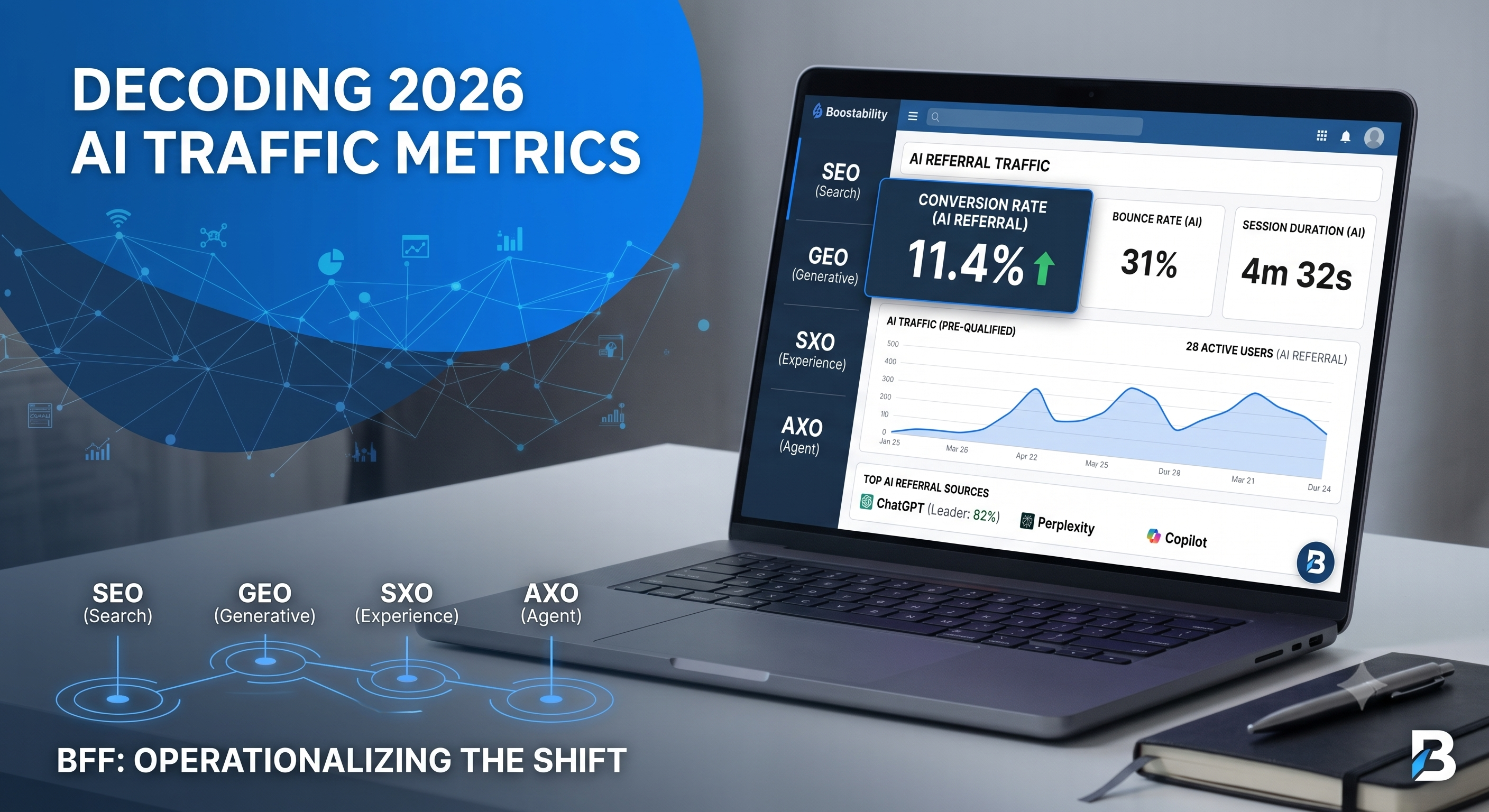
Our modern Be Found Framework (BFF), visualized in Screenshot 2026-07-21 234554.png, operationalizes this by utilizing four interdependent, technical pillars. This model allows us to differentiate the experience your business provides from the intelligence AI delivers:
The BFF AI-Search Philosophy (4 Pillars)
Pillar 1: SEO (Search) – Foundational Technical Health
Foundational SEO is not optional; it is the prerequisite for all visibility. BFF ensures perfect technical health, crawlability, and local entity clarity. This includes optimizing technical schema and local structured data so that both traditional search engines and emergent LLM crawlers like GPTBot and PerplexityBot can accurately parse service areas, availability, and service menus. We structure the data exactly how answer engines expect to consume it.
Pillar 2: GEO (Generative) – Entity Clarity & Authority
This is your brand authority footprint. Data from DataDome shows leading conversational engines (commanding over 80% of referral market share) rely heavily on cited sources that show strong, widespread brand visibility. BFF ensures small businesses appear accurately across authoritative third-party directories, niche vertical citations, verified review sites, and trusted news publications. We build authentic presence that AI engines recognize as reputable.
Pillar 3: SXO (Experience) – The Human-Led Differentiator
This is where BFF differentiates the experience from the AI’s intelligence. Answer engines can summarize facts, but they cannot prove human reliability. While Google’s AI View handles the initial summary, BFF focuses on deep, expert-led content (AEO), verified client case studies, rich interactive tools, robust project galleries, and authenticated user stories. SXO provides the real-world evidence of trust (satisfying E-E-A-T) that a chatbot summary cannot replicate, decreasing bounce rates (which are 33% lower on AI citations) and driving final conversion.
Pillar 4: AXO (Agent) – Optimizing for Autonomous Agents
The future of search is personal. Data from HUMAN Security shows agentic AI traffic grew 7,851% YoY. If a user says, “My personal assistant agent should schedule an appointment with that top HVAC firm in Denver,” your site must be optimized for this automated transaction. AXO structures content for direct retrieval, ensures API friendliness where necessary, and builds conversational interfaces that allow a user’s agent to transact with your client’s site directly. We are optimizing for the agent as the customer.
Navigating “Dark AI” Traffic for Partners & Agencies
One of the greatest technical challenges for agencies in 2026 is proper attribution. The Loamly State of AI Traffic Report discovered that over 70% of AI referral traffic lands without standard HTTP referrer headers.
When an answer engine or mobile AI desktop application directs a user to a client site, traditional analytics tools like Google Analytics 4 (GA4) often misclassify this visitor as “Direct” traffic. Agencies cannot prove the ROI of their efforts without visibility. At Boostability, our agency reporting dashboards explicitly isolate these direct landing surges on deep, service-specific URLs, giving agency partners clear, measurable visibility into the true impact and conversion path generated by AI search visibility.
What This Means for SMBs and the Future Search Landscape
The rise of AI search is not a death sentence for SMB visibility; it is a profound equalizer. Large enterprise brands can no longer rely solely on massive budgets to dominate generic high-volume keywords.
- Intent Trumps Volume: 100 pre-qualified, high-intent visitors from an AI citation generate significantly more revenue than 2,000 casual visitors bouncing off a generic blog page.
- Human-Led Strategy differentiates: As AI models summarize the web, they crave fresh, authentic, human-verified perspectives—the cornerstone of modern SXO.
- Multi-Engine Presence is Required: Optimization must expand beyond a single search engine to include visibility across ChatGPT, Perplexity, Copilot, and Gemini.
By ground-up operationalizing search strategy through Boostability’s modern Be Found Framework (BFF), SMBs and agency partners can navigate this shift with absolute confidence—turning changing search behaviors into sustainable, long-term growth.
Research & Data References
- DataDome Threat Research: The AI Traffic Report Q2 2026
- HUMAN Security: 2026 State of AI Traffic & Cyberthreat Benchmark Report
- Adobe Digital Insights: 2026 AI Travel & Retail Traffic Surges Report
- Loamly AI: State of AI Traffic 2026 Benchmark Report
- Elementor & xSeek: 2026 AI Search & CTR Benchmarks
- Semrush & Microsoft Clarity: 2026 Conversion and Engagement Rates across Generative Search Channels
