Be Found Framework (BFF): How Businesses Win in the AI Search Era

Futuristic digital graphic titled "Be Found Framework (BFF): How Businesses Win in the AI Search Era." The glowing neon illustration features a digital brain with a magnifying glass inside a browser interface, connected to global networks, cityscapes, and algorithms, all converging on a central hub labeled "BFF
What's Inside?


    Welcome to the new era of search. For years, being "found" online simply meant showing up as a blue link on Google. Today, people are asking complex questions to AI chatbots like ChatGPT, getting instant summaries from Google's AI Overviews, and eventually, having AI assistants book appointments for them.

    The jargon can sound overwhelming, but the goal remains the same: making sure your business is the one people (and AI) find, trust, and choose. We know that authentic, human-led expertise is what ultimately drives value, but we must structure that expertise so AI systems can understand it. This playbook breaks down the modernized 4-Pillar Be Found Framework (BFF) in plain English, complete with real-world scenarios to help you grasp these concepts immediately.


    The 2026 Reality: Why the BFF is Necessary

    We are no longer predicting the AI shift; we are living in it. The fundamental contract between brands and search engines—rank well, get traffic—has permanently changed. According to the most recent 2025/2026 clickstream data and industry research, the need for a multi-layered framework like the BFF is undeniable:

    • The 68% Zero-Click Baseline: According to 2026 data from SparkToro and Similarweb, a staggering 68% of all US Google searches now end without a single click to the open web. Users are getting their answers directly on the search page.
      zero click search infographic (1)
    • The AI Overview CTR Collapse: When an AI Overview is present, that zero-click rate skyrockets to 83%. Multiple studies (including Ahrefs and Seer Interactive) confirm that organic click-through rates (CTR) drop by 58% to 61% the moment an AI Overview appears on a query. Only about 1% of users actually click the citation links embedded inside the AI Overview itself.

      Infographic by Boostability titled "The AI Overview Effect." It illustrates that when Google shows an AI Overview, website clicks decline. Three data cards highlight that 83% of searches become zero-click, organic CTR drops by 58 to 61 percent based on Ahrefs and Seer Interactive studies, and citation click rates are only 1%. A bottom section diagrams the business shift from Traditional SEO to GEO and AEO.

      AI Overviews are fundamentally changing how users interact with search results, dramatically reducing traditional website clicks.


    • The High Intent AI Buyer: While overall traffic volume is down, the value of the remaining traffic has never been higher. Adobe Digital Insights reported in early 2026 that traffic arriving at U.S. retailers from AI sources (like ChatGPT or Perplexity) converted roughly 42% better than non-AI traffic. Users arriving from AI chatbots have already completed their research—they arrive ready to buy.

    This data proves that you can no longer rely on Pillar 1 (SEO) alone. You must optimize for the AI Answer Layer (GEO) to maintain brand affinity, and the Action Layer (AIO) to capture the highly-qualified, ready-to-convert traffic.


    The Core Concept: The "Centroid" (Becoming the Center of Gravity)

    Before diving into the pillars, you need to understand how AI systems think. They don't read websites the way humans do; they organize information mathematically into clusters. We call the center of these clusters the Centroid.

    What it means: The Centroid is the ultimate, central authority on a specific topic or in a specific location. If your business is the "Semantic Centroid" for a topic, AI views you as the absolute center of gravity for that subject. When someone asks a question, the AI pulls from the center first.

    Infographic by Boostability titled "The AI Authority Gravity Well." A concentric circle diagram shows Boostability at the center as the "AI Authority Center," surrounded by owned and managed signals. Orbiting this center are third-party validation and consensus signals like industry publications, reviews, Reddit, local listings, and news mentions. A bottom section states AI models look for brands at the center of trusted information networks, not just the loudest brand.

    Building your brand into an AI Authority Gravity Well requires a strategic, human-led approach.


    • Geographic Centroid (Local Authority): You are the physical epicenter of a searcher's needs.An informational card titled "Geographic Centroid" focusing on Local Authority. The text explains that a business becomes the recognized local reference point for its market. A downward flow diagram shows that Reviews, Listings, and Location Signals lead to Local Authority, which ultimately results in an AI Citation.
    • Semantic Centroid (Topic Authority): You are the go-to expert. Your content covers a topic so thoroughly and accurately that AI defaults to citing you. 1

    For years, being "found" online simply meant showing up as a blue link on Google. Today, the search landscape has split permanently. People are asking complex questions to AI chatbots like ChatGPT, getting instant summaries from Google's AI Overviews, and having autonomous AI assistants book appointments for them.

    The jargon can sound overwhelming, but the goal remains exactly the same: making sure your business is the one people (and AI) find, trust, and choose. We know that authentic, human-led expertise is what ultimately drives value, but we must structure that expertise so AI systems can understand it.

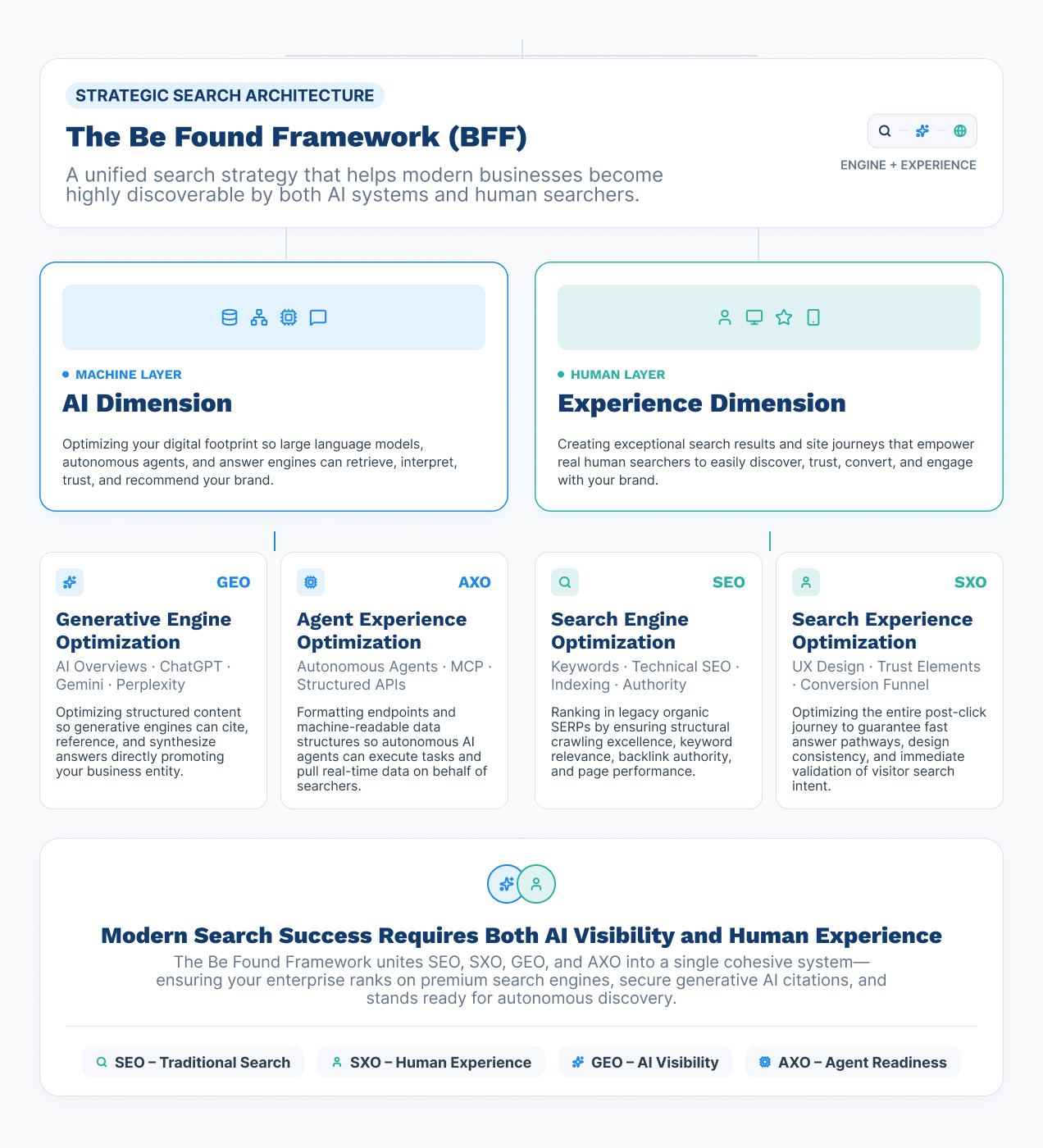
    To help small businesses navigate this shift, Boostability developed the Be Found Framework (BFF)—a modernized, multi-layered search strategy built on four core pillars.

    The 4 Pillars of the Be Found Framework

    Pillar 1: Evolved SEO & AI SEO – The Blueprint Layer

    Traditional SEO is the architectural blueprint of your physical retail store, ensuring search engines can map your location, find your services, and list you in organic results. AI SEO is the modern upgrade built onto that blueprint. It adds clear, high-contrast digital barcodes to every asset so that automated AI crawlers (used by OpenAI, Google, and Perplexity) can seamlessly scan, extract, and index your data in milliseconds.

    • Why it Matters & Business Impact: AI engines do not invent business data out of thin air; they pull it from trusted, indexed websites. If your technical blueprint is broken, slow, or buried in messy code, the AI bots will simply bypass your site for a competitor whose digital foundation is easier to read.
    • The 2026 Reality & Data Connection: To feed the AI layer, the underlying technical blueprint must be flawless. AI crawlers favor text-first extraction and frequently skip sites with heavy, unoptimized code. Furthermore, data reveals that nearly half of all AI search citations do not overlap with top-ranking organic "blue-link" results. This proves that AI models aren't just looking for traditional keyword density—they are choosing websites with the cleanest, most schema-rich technical structures.

    The Action Plan:

    • Schema Markup (The Machine Translator): Deploy backend data tags that explicitly tell LLMs exactly what your data means (e.g., "This is our price, this is our service area, and this is our phone number").
    • Technical Cleanliness & Speed: Clean up bloated website code and optimize images so AI bots can crawl and extract your data instantly without timing out.
    • Direct-Answer Formatting: Place highly explicit, 2-to-3 sentence definitions right beneath clear page headers so bots can easily clip it as a citation.


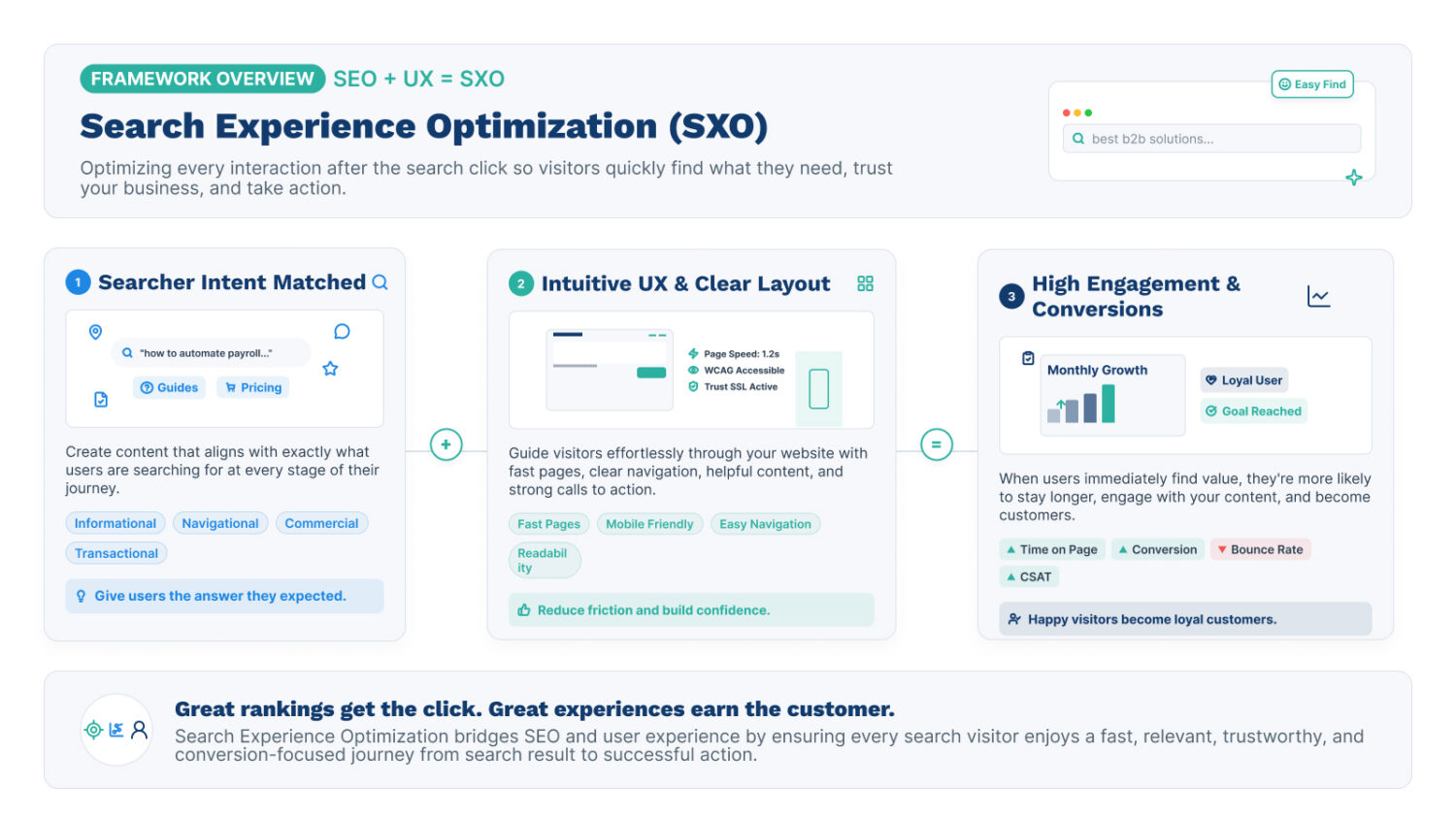
    Pillar 2: SXO (Search Experience Optimization) – The Human Validation Layer

    SXO is what happens once a user actually crosses your digital threshold. If your technical blueprint gets them to click, SXO ensures they find a fast, intuitive, and welcoming experience that immediately answers their questions, preventing them from turning around and leaving.

    • Why it Matters & Business Impact: Search engines and AI models monitor user behavior closely. If a human clicks your website link and immediately hits the "back" button (known as bouncing), algorithms assume your business isn't genuinely helpful, causing your visibility to drop across the entire web.
    • The 2026 Reality & Data Connection: Google's core algorithms aggressively prioritize E-E-A-T (Experience, Expertise, Authoritativeness, and Trust). Because generative AI tools make it effortless for anyone to churn out generic, low-quality text, authentic and human-crafted user experiences are your only defense. High engagement signals to search platforms that your brand is a trusted, real-world authority, directly protecting you from traffic drops.

    The Action Plan:

    • Information Gain Content: Provide unique, human-led perspectives, proprietary data, and real-world experience that an AI cannot simulate or hallucinate.
    • Frictionless Mobile Design: Eliminate intrusive pop-ups, slow loading times, and confusing menus so human users get answers instantly on any device.
    • Clear Conversion Paths: Build an intuitive layout where phone numbers, contact forms, and booking buttons are always a single click away.


    Pillar 3: GEO (Generative Engine Optimization) – The AI Answer Layer

    Imagine a customer asking a highly knowledgeable hotel concierge for a direct recommendation. The concierge doesn't hand them a massive phone directory; they summarize the options and name one or two top-tier businesses. GEO is the art of shaping your brand's digital footprints so AI engines choose your business as that definitive recommendation.

    • Why it Matters & Business Impact: Consumer search habits have permanently fractured. Instead of scrolling through an old-school list of search links, buyers are asking complex questions and reading conversational summaries. If you aren't optimized for GEO, your competitors will be the ones recommended in the AI's response paragraph.
    • The 2026 Reality & Data Connection: This layer directly solves the modern 68% zero-click search baseline. Because traditional organic click-through rates drop by roughly 60% (and up to 83% when an AI Overview is present), GEO ensures you capture premium "Share of Voice" right on the search page, earning brand affinity even when the user doesn't click.

    The Action Plan:

    • Content Chunking: Restructure long articles into bite-sized, highly structured factual segments, bulleted lists, and explicit FAQ sections that AI engines love to scrape.
    • Entity Health & Consistency: Audit your brand name, address, and services across external directories (Yelp, Google Business Profile) to ensure they are written identically. High-traffic brands with consistent review profiles have a 3x higher citation chance in AI Overviews.
    • Citation Engineering: Author primary source data, case studies, and expert quotes that AI engines are highly likely to reference and link back to as programmatic proof.


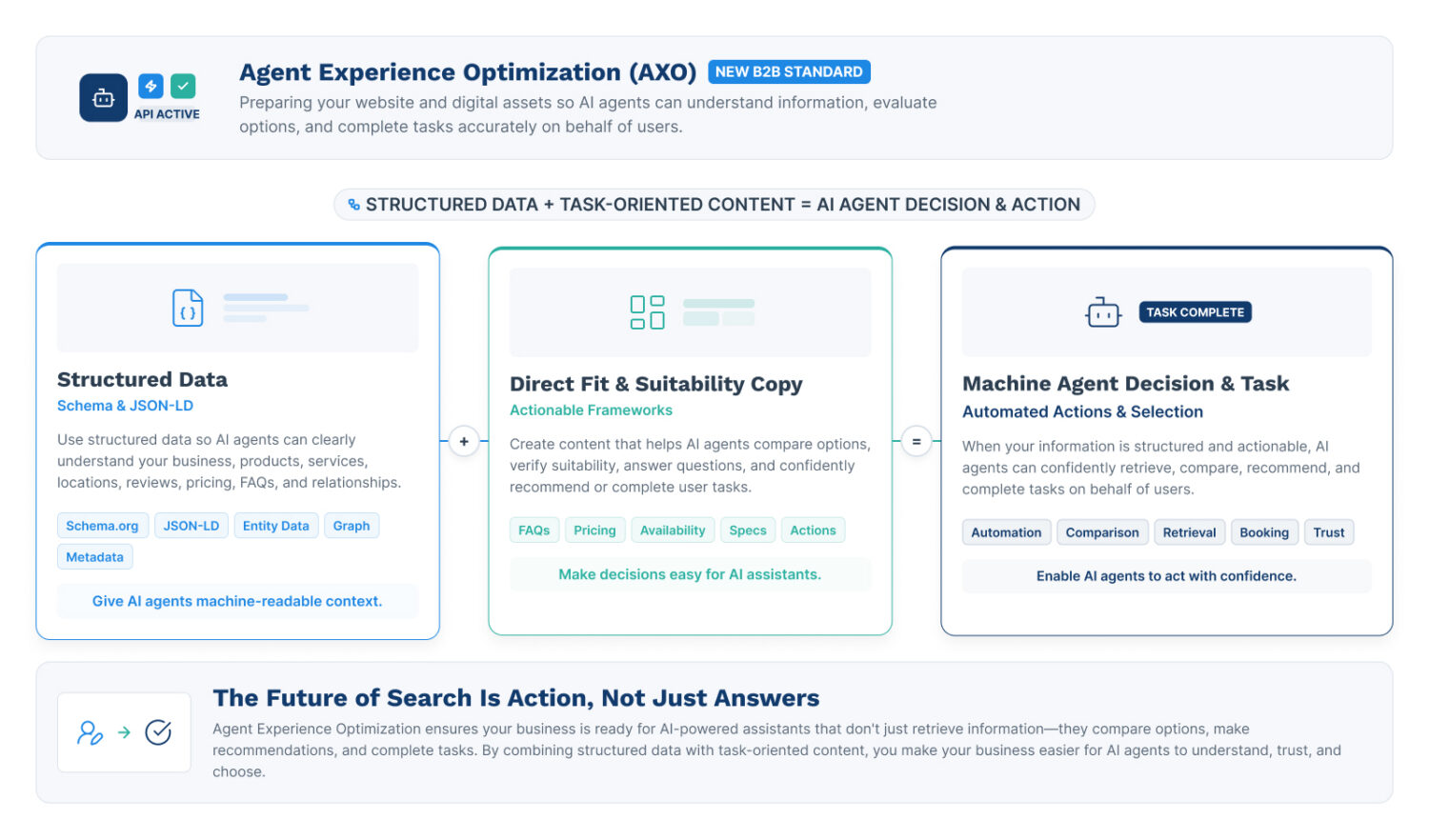
    Pillar 4: AIO (AI Interaction Optimization) – The Action Layer

    This is the transaction engine of the future. AIO prepares your real-time data feeds, booking systems, and item pricing to be completely open and readable by autonomous AI personal assistants so they can handle appointments, check inventory, and place orders directly on behalf of real people.

    • Why it Matters & Business Impact: If your business systems cannot talk directly to AI software, you become completely locked out from a massive, fast-growing segment of busy consumers who delegate their daily purchasing tasks to digital assistants.
    • The 2026 Reality & Data Connection: Traffic arriving at digital ecosystems via AI channels converts roughly 42% better than traditional non-AI traffic. Why? Because the AI has already filtered the options and handled the consideration phase. When that high-intent consumer arrives at the transaction line, AIO ensures your backend systems close the sale frictionlessly.

    The Action Plan:

    • Machine-Readable Feeds: Clean up and open your local listings, product catalogs, and service pricing structures so automated web agents can read your live data.
    • API & Booking Integration: Connect open scheduling software APIs to your site so that an AI assistant (like Apple Intelligence) can instantly check real-time availability and place holds.
    • Trust Token Optimization: Secure high ratings and consistent reviews on verified platforms (like Google Business Profile), giving autonomous AI agents the algorithmic confidence to safely transact with you.


    The Dual-Funnel Reality: How Search Has Split

    Now that you know the pillars, let's look at the battlefield. Your customers are no longer walking down a single path. Instead, they are split across two entirely different journeys:

    • The Traditional SEO Funnel: This is the classic, manual journey. The user does all the heavy lifting. They type a query, scroll through an interrupted list of links, open 5 to 10 tabs, manually cross-reference information, and eventually decide who to trust. In this funnel, maximizing traditional website traffic and ranking positions is what keeps your business alive.
    • The Modern AEO Funnel: This is the AI-driven journey. The AI does the heavy lifting. The user asks a natural question and receives a single, conversational, synthesized answer with only 2 or 3 sources cited as proof. The AI handles the filtering, comparison, and recommendation steps behind the scenes, allowing the user to make decisions without switching tabs or even clicking through to a website.

    Most businesses only build strategies for the left funnel—leaving them completely invisible in the right one. The BFF ensures you capture both simultaneously.


    Bringing it to Life: The Journey of Jane

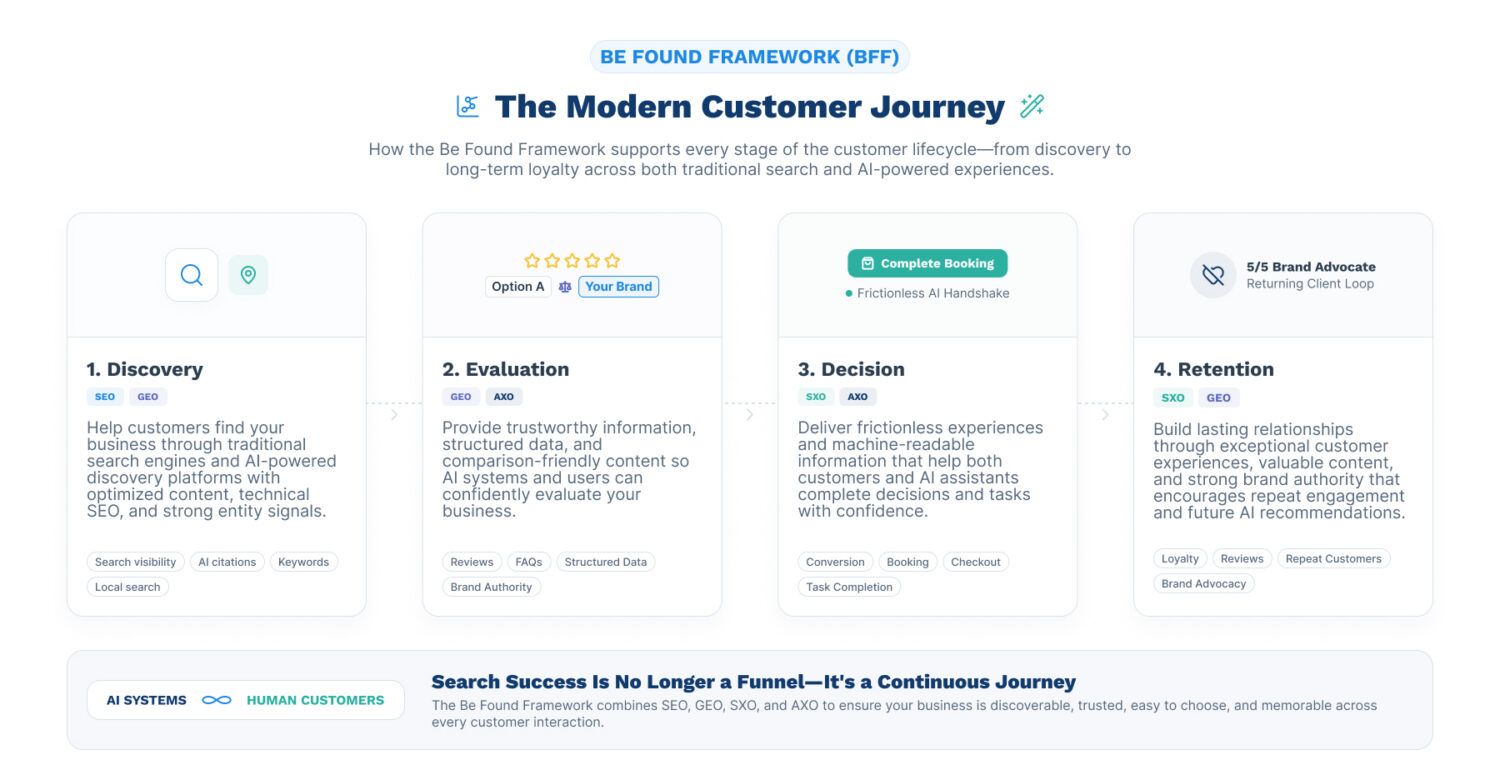
    To see how these pillars and funnels seamlessly combine in the real world, let’s follow a modern buyer named Jane who needs to remodel her outdated kitchen. Her journey is driven by the four fundamental search moments defined by Google: Know, Go, Do, and Buy.

    Depending on which funnel Jane uses, her experience—and the pillars that capture her—look completely different:


    0

    1. The "I Want to Know" Moment (Top of Funnel / Awareness)

    • The Intent: Jane is looking for inspiration and wants to explore open-concept kitchen layouts.
    • The Traditional SEO Funnel: Jane types "open concept kitchen ideas" into Google. She gets interrupted by a massive list of links. She clicks 3 different blogs, gets hit with pop-up ads, scrolls through endless generic introductory text, and feels overwhelmed.
    • The Modern AEO Funnel: Jane asks ChatGPT: "What are the pros and cons of an open-concept kitchen for a small home?" The AI does the research for her, instantly generating a single, beautifully synthesized list of pros and cons. Tucked right into that text is a citation referencing Oak & Stone Construction as the expert source.

    1

    BFF in Action: Pillar 3 (GEO) ensures Oak & Stone’s content is formatted so perfectly that the AI copies their exact facts, earning immediate brand trust from Jane right on the search page without requiring a website click.


    2. The "I Want to Go" Moment (Middle of Funnel / Consideration)

    • The Intent: Jane has decided she wants to move forward and needs to find a highly rated contractor right in her neighborhood.
    • The Traditional SEO Funnel: Jane searches "kitchen remodeling contractors near me". She opens 5 different tabs, looking at maps and websites to see who is actually local and open.
    • The Modern AEO Funnel: Jane asks her AI assistant: "Which local kitchen contractors near me specialize in modern designs and have 5-star ratings?" The AI screens local entity profiles and highlights Oak & Stone Construction, showing their address and a quick summary of their glowing reviews.

    BFF in Action: Pillar 1 (Evolved SEO) ensures that Oak & Stone's backend code and local listings are perfectly synchronized, making it incredibly easy for both human eyes and AI crawlers to verify their physical location and authority.


    2

    3. The "I Want to Do" Moment (Middle of Funnel / Consideration)

    • The Intent: Jane wants to prepare for the process and wonders what steps she needs to take before a contractor arrives.
    • The Traditional SEO Funnel: Jane browses more articles, manually comparing different prep checklists across multiple open tabs to form her own conclusion.
    • The Modern AEO Funnel: Jane reads the AI's summarized prep guide, which directly links to a case study on Oak & Stone's website detailing a real-world project checklist. Jane clicks the link to explore further.

    BFF in Action: Pillar 2 (SXO) takes over the moment Jane lands on the site. Instead of generic text, she finds an ultra-fast, beautifully designed mobile page packed with Information Gain—real project photos, local building code tips, and transparent timelines. Jane is completely hooked by the premium human experience.


    4. The "I Want to Buy" Moment (Bottom of Funnel / Action)

    • The Intent: Jane is ready to lock in a consultation and start her project.
    • The Traditional SEO Funnel: Jane manually navigates to the contact page, fills out a lengthy form, and waits for an email response.
    • The Modern AEO Funnel: Jane tells her smartphone's AI assistant: "Book a consultation with Oak & Stone Construction for this Thursday afternoon." The AI directly interacts with the business's systems and places the appointment straight onto her calendar.

    3


    BFF in Action: Pillar 4 (AIO) ensures Oak & Stone's scheduling calendar is completely machine-readable and open to web agents, turning Jane’s high-intent decision into an instant, frictionless conversion.


    Summary: Winning Both Funnels Simultaneously

    Jane's Journey Traditional SEO Funnel(User Does the Research) Modern AEO Funnel(AI Does the Research) Active BFF Pillar
    1. Know (TOFU) The user scrolls a list of ranked results. The user reads one synthesized answer with 2-3 citations. Pillar 3: GEO
    2. Go & 3. Do (MOFU) The user opens 5-10 tabs to manually compare sites. AI compares the sources internally; the user trusts synthesis. Pillar 1: Evolved SEO

    Pillar 2: SXO

    4. Buy (BOFU) The user manually navigates and takes action on-site. The user acts on recommendation, often without a website click. Pillar 4: AIO

    4

    The Future of Search Marketing

    The Be Found Framework operationalizes this shift; it is future-proof search marketing. We are moving toward an environment where users don’t just search—they converse, delegate, and act through AI systems.

    Visibility will depend on being understood by those systems as much as by people. That is why BFF isn’t just a response to change; it’s a foundation for long-term adaptability. By combining the proven fundamentals of SEO with the emerging disciplines of generative and answer optimization, Boostability equips businesses to stay visible through every evolution of search.


    FAQs for Small Business Owners: AI Search & Your Bottom Line

    1. What exactly is the Be Found Framework (BFF)?

    Think of the BFF as your business’s “visibility game plan” for the AI era. It pulls together everything that helps people find you online—from traditional SEO to being mentioned by AI tools. The goal is to help your business get noticed, trusted, and chosen no matter where people search today.

    1. Do I still need SEO if AI is doing all the answering?

    Short answer: Yes, absolutely! SEO remains the backbone of digital visibility. The difference is where people meet your business. SEO is still foundational, but it must be combined with the other disciplines in the 4-pillar BFF to succeed today.

    1. Why is my web traffic dropping even though I rank well?

    Search is changing! Today, over 68% of Google searches end without a click. When users get their answers directly from AI Overviews or tools like ChatGPT, it leads to the "zero-click" era. For informational questions, organic traffic can drop by nearly 60%. You're still visible, but the interaction is happening directly on the search page. The goal is now focused on brand affinity at this initial research stage.

    1. What are GEO and AIO?

    These are the specialized types of optimization in the modernized BFF:

    GEO (Generative Engine Optimization): Helps your content show up inside Google’s AI Overviews and helps AI tools like ChatGPT recognize your business as a trusted source to be cited.

    AIO (AI Interaction Optimization): Prepares your data (like product feeds and listings) so AI agents can take action—like booking appointments or recommending your services.

    1. How does SXO help turn AI visibility into customers?

    SXO (Search Experience Optimization) is all about what happens after someone discovers you. It ensures your website answers the right questions and guides visitors to take action. Even if a customer finds you through an AI answer, SXO helps turn that visibility into measurable engagement.

    1. What is E-E-A-T and why does it matter to AI?

    E-E-A-T stands for: Experience, Expertise, Authoritativeness, and Trust. AI systems use these signals to decide which businesses deserve to be featured. Content that demonstrates real-world human experience and verifiable accuracy is far more likely to be cited by AI.

    1. What is “entity health” and why should I care?

    Your “entity” is your business’s online identity. Good entity health means your information (name, services, hours) is consistent everywhere. When your information is clean, AI and search engines trust you more.

    1. How should I measure success today, beyond SEO rankings?

    In the AI era, traditional rankings don't tell the full story. Indicators that matter include:

    - Do you appear in AI Overviews?

    - Do LLMs (like ChatGPT) mention your business?

    - Is your branded search lift growing?

    - Is your business info accurate and consistent everywhere online (entity health)?

    1. Will AI replace SEO completely?

    No—AI won’t replace SEO. It’s transforming it. SEO today is still essential, but it has evolved into a broader umbrella encompassing the 4 pillars of the BFF (SEO, SXO, GEO, AIO).

    1. How does Boostability help small businesses prepare for AI?

    We live by our mission: "We help small businesses succeed online." In the AI era, that means turning the technical complexity of the BFF into results for you. We handle the complexity—making your data machine-readable and strengthening E-E-A-T signals—so you can focus on running your business.

    1. Is BFF only for big companies, or does it help small businesses most?

    The BFF is designed to help any business that depends on digital discovery. It aligns perfectly with our vision: "We envision a future where every business, regardless of size or industry, can harness the power of the internet to reach their full potential."

    Save this Guide for Later

    Prefer to read offline? Fill out the form below to get the full Be Found Framework PDF sent directly to your inbox. Perfect for printing or sharing with your team.

    Beth Yap

    Beth Yap

    With a decade of experience in digital marketing, Beth crafts compelling content that captivates audiences and drives results. A passionate storyteller and digital strategist, she brings a unique perspective to her work. When she's not crafting content, you can find her exploring the great outdoors or indulging in her love for Harry Potter.