
Why Your Small Business Needs to Capture “AI Citations” Now

Search is changing fast. Here is the practical guide for US small businesses to survive the shift to ChatGPT search and the new world of AI recommendations.
For twenty years, the goal for any small business was simple: Get to the top of Google’s “ten blue links.” If you were rank #1 for “plumber in Dallas” or “boutique in Chicago,” your phone rang.
That era is ending.
Today, customers aren’t just searching; they are having conversations. They are asking ChatGPT for a full itinerary for their weekend trip, or asking Google’s AI to recommend the best reliable mechanic for a specific type of car.
In this new world, the AI doesn’t always send the user to your website. Instead, it reads your website, reads reviews about you on other sites, and then summarily “recommends” you directly in the chat.
This is part of a larger shift toward the Be Found Framework (BFF)—a holistic approach to visibility that includes SEO, AEO, GEO, and specifically AIO, sometimes Citation Authority. You need the AI to trust your business enough to cite it as the answer.
Here is the honest breakdown of the pros and cons of this new reality for the American small business owner, and exactly what you need to do about it.
What is AIO (AI Interaction Optimization)?
AI Interaction Optimization (AIO) is the process of optimizing your online presence so that AI “agents” (like ChatGPT, Google Gemini, or Perplexity) can easily understand who you are, what you sell, and where you are located, compelling them to mention and recommend your brand in conversational answers.
The Pros and Cons of the AI Search Revolution
This shift is scary, but it also levels the playing field in ways traditional Google search never could.
The Pros: Why This is Good for Small Business
- The Playing Field gets Leveled (Quality over Budget) In the old days, giant corporations with massive budgets could buy thousands of backlinks to dominate the top spots. AI models are smarter. They prioritize genuine relevance and helpfulness over brute-force link building. A local bakery with incredible, specific content about their gluten-free process can now be recommended over a national chain that just has a generic landing page.
- Higher “Intent” Customers When someone types “pizza” into Google, they could want anything—a photo, a recipe, or a delivery. But when someone asks ChatGPT, “I need a pizza place that is still open near downtown and has good vegan options for my daughter,” that customer is ready to buy right now. If the AI cites your business as the answer to that complex question, the lead quality is incredibly high.
- Local Context is King AI models rely heavily on geography and context. They are getting better at understanding “near me” in a very hyper-local sense. This gives the advantage to the actual local business over national directories trying to rank for local terms.
The Cons: The Challenges You Must Face
- The “Zero-Click” Threat This is the biggest danger. If a user asks, “What are the hours of Joe’s Hardware?” and the AI answers “They are open until 6 PM,” the user never visits Joe’s website. You lose the traffic, the chance to show them ads, and the chance to capture their email. Your information must be optimized so the AI wants to send users to you for more details.
- Loss of Brand Control You cannot control exactly how ChatGPT summarizes your business. It might describe your services slightly incorrectly based on outdated information it found on a random Yelp review from 2022. This makes keeping your information consistent across the entire web more vital than ever.
- The Technical Barrier (Schema Markup) AI robots don’t read webpages like humans do; they prefer code. If your website doesn’t have “Structured Data” (Schema) setup correctly, the AI might not even know you are a local business, regardless of what the text on your homepage says.
The New Curveball: ChatGPT Ads
Just as businesses are getting used to organic AI responses, OpenAI has announced that ads are coming to ChatGPT in early 2026.
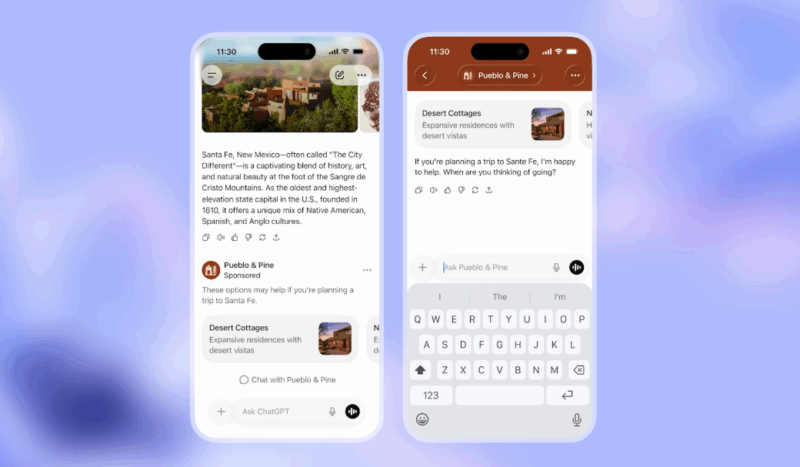
An example of sponsored content and brand integration within a generative AI chat experience.
Why it’s happening: Running AI is expensive. OpenAI needs revenue to keep a free version available to the public.
What it means for you: Unlike a static Google banner ad, ChatGPT ads will likely be “sponsored recommendations” that appear contextually during a conversation.
If your organic efforts fail to get you mentioned by the AI, you will soon have the option to pay to be injected into the conversation as a relevant suggestion. This will likely become a necessary channel for competitive local markets (like HVAC, legal, or real estate).
Your Action Plan: How to Capture “AI Citations”
You don’t need to be a coder to adapt, but you do need to change your strategy. Here are three specific steps for US small businesses.
Step 1: Speak “Robot” with Structured Data (Schema)
The AI needs to know definitively what your business is. You do this using Schema markup—invisible code on your site that tells search engines what the data means.
- The Instruction: Ensure your website uses LocalBusiness Schema. This code must accurately list your Name, Address, Phone Number (NAP), opening hours, price range, and exactly what services you offer.
- The Example: Without Schema, an AI sees “9-5” on your page and guesses its hours. With Schema, it knows those are opening hours for Monday-Friday at your specific GPS coordinates. If you are a Boostability customer, ask your account manager to confirm your LocalBusiness Schema is spotless.
Step 2: Become “Mentionable” on Third-Party Sites
AI models don’t just trust what you say about yourself on your own website. They look for “corroboration” from other trusted sources to verify you are legitimate.
- The Instruction: Do an audit of your business information on major directories (Google Business Profile, Yelp, Apple Maps, Bing Places) and niche industry sites (e.g., Avvo for lawyers, Houzz for contractors).
- The Goal: Your Name, Address, and Phone number must be identical everywhere. Furthermore, getting mentioned in local news blogs or chamber of commerce websites acts as “proof” to the AI that you are a real, active entity in your community.
Step 3: Answer Complex Questions Clearly
Stop focusing on two-word keywords like “Denver Accountant.” AI handles long, complex queries. Your content needs to answer them directly.
- The Instruction: Create an FAQ section or blog posts that answer specific, conversational questions your customers actually ask. Use a clear “Question / Direct Answer” format.
- The Example:
- Old SEO: A page targeting the keyword “Small Business Tax Help.”
- Agentic SEO: A blog post titled: “How do recent changes to Section 179 deductions affect small businesses in Ohio?” followed by a clear, concise summary paragraph answering that exact question.
The Bottom Line
The era of just “ranking” is over. The era of being the trusted, cited answer has begun. By cleaning up your technical data and ensuring your reputation is solid across the web, you can turn these AI agents into your best 24/7 referral partners.
Frequently Asked Questions about Agentic SEO
- How will ChatGPT ads affect my small business? ChatGPT ads, arriving in early 2026, will appear as “Sponsored Recommendations” within a chat. For small businesses, this is an opportunity to be suggested at the exact moment a customer expresses intent. Unlike traditional banners, these ads are conversational and can lead to direct customer engagement.
- What is an “AI Citation” and how do I get one? An AI Citation is when an AI tool mentions your brand as a source or recommendation. To get one, you must maintain consistent business information (NAP) across the web and use structured data (Schema) so the AI can verify your services and authority.
- Why is ChatGPT adding ads to its search results? OpenAI is opting for ads to offset the massive computing costs of AI and to keep the platform accessible to free users. This move allows them to compete directly with Google by offering businesses a way to reach users who are moving away from traditional search engines.
You Run Your Business. We’ll Make Sure the World (and the AI) Finds It.
Between managing your team and serving your customers, you shouldn’t have to worry about the latest Google algorithm update or ChatGPT’s new ad model. That’s our job.
Boostability was built to give small businesses the same digital firepower as the big guys. This year, we’re helping thousands of US small businesses transition into the era of Conversational Search. Let us handle the Schema, the citations, and the strategy, so when a customer asks their AI for the best in town, it says your name.
Schedule Your 2026 Strategy Session with Boostability
