

The landscape of digital visibility is undergoing one of the most profound shifts since the birth of search engines. The era of traditional SEO, while still foundational, is no longer the singular pathway to growth. As artificial intelligence weaves itself deeper into search engines, content discovery, and user interactions, search is splitting in five key directions.
To compete—and more importantly, to thrive—you need a strategy that addresses all five pillars of search visibility. We call it the Be Found Framework (BFF) because it captures the complete, multi-channel approach to digital discovery in the age of AI — where success comes from mastering all five pillars (SEO, CRO, AEO, GEO, AIO) as an interconnected system.
This isn’t just a technical shift; it’s a fundamental change in how businesses think about attracting, engaging, and converting an audience. Success is no longer about keyword rankings alone—it requires connecting the full discovery stack, from capturing attention in zero-click results, to influencing AI-generated answers, to converting visitors with seamless on-site experiences.
The Five Pillars of Be Found Framework (BFF)
| Optimization Type | Primary Goal | Target Audience | Key Differentiator | |
| Traditional Search Pillars | SEO | Rank pages in organic search results. | Users looking for specific keywords. | Focus on the link: The goal is to get a user to click on your link from the search results page. |
| CRO | Optimize the post-click user journey for conversions. | Visitors already on your site. | Focus on the experience: Turn traffic into outcomes. | |
| AI Search Pillar | AIO | Make content machine-readable for AI systems. | AI models and knowledge bases. | Focus on the data: Ensure your information is consistently and accurately understood and stored. |
| AEO | Win “zero-click” answers and featured snippets. | Users seeking quick, direct answers. | Focus on the answer: Become the definitive solution shown directly in the SERPs, regardless of a click. | |
| GEO | Earn visibility as a cited source in AI-generated responses. | Users relying on conversational AI tools like ChatGPT or Gemini. | Focus on the citation: Be the trusted authority AI references when generating its own answer. |
SEO: The Foundational Pillar
SEO stands for Search Engine Optimization. It’s the foundational practice of optimizing web content to rank in organic search results. It’s about earning authority through content, backlinks, and technical health to drive high-intent traffic.
Example Search: A user types “best small business accounting software” into Google. SEO ensures your blog post comparing top accounting tools ranks in the top 3 results.
The Major Difference: The fundamental goal is to earn the click. SEO is a direct traffic-driving strategy, where your rank and visibility directly correlate to the number of visitors you get. According to a BrightEdge study, 53% of all website traffic still comes from organic search, proving its continued importance as the primary channel.
- Pros: Generates highly qualified traffic, builds long-term brand authority, and provides a strong return on investment. Once you rank, the traffic is essentially free, unlike paid ads.
- Cons: It’s a long game; results can take months to appear. The space is highly competitive, and algorithmic changes can affect your rankings without warning.
How to Rank Higher
Master Keyword Research: Focus on a mix of informational and transactional keywords that align with user intent throughout their search journey. For example, target queries like “how to fix a leaky faucet” (informational) to capture users early in the research phase, as well as terms like “emergency plumber near me” (transactional) to reach those ready to take action. This balanced approach helps attract a wider audience and improves your visibility at multiple stages of the funnel.
- Build High-Quality Backlinks: Earn links from reputable websites in your industry. This is a powerful signal of authority to search engines.
- Prioritize E-E-A-T: Demonstrate your Experience, Expertise, Authoritativeness, and Trustworthiness by showcasing author bios, citing credible sources, and keeping content up-to-date.Learn more about E-E-A-T from our Comprehensive Guide.
CRO: The Conversion Layer
CRO, or Conversion Rate Optimization, is a holistic approach that combines traditional SEO with user experience (UX) design. While SEO’s main goal is to get a user to a website, CRO goes a step further by focusing on the user’s journey after they click a link, ensuring a positive experience that leads to conversion. This approach aims to create a site that is both easy to find and enjoyable to use.
Key Principles of CRO
CRO focuses on the full user journey, from the initial search query to the final action on your site. Its major components are:
- SEO Basics: CRO is built on a foundation of SEO. This includes keyword research, on-page optimization, and technical SEO elements like site speed and mobile-friendliness.
- User Experience (UX): At the heart of CRO, UX prioritizes ease of navigation, intuitive design, accessibility, and content readability. A well-structured site with clear menus and an appealing design keeps visitors engaged.
- Engagement Metrics: To ensure a great experience, CRO monitors user behavior using metrics like bounce rate and average time on page. Analyzing this data helps to identify areas for improvement and guide future decisions.
- Content Quality: Content must be helpful and relevant. High-quality content not only helps with search rankings but also keeps users engaged and encourages them to explore your site further.
How CRO Differs from SEO
The key distinction is in the scope and metrics used to measure success.
While SEO and CRO have different goals, they work best when used together. SEO focuses on attracting the right visitors to your website by improving visibility in search results through strategies like optimizing content, earning backlinks, and enhancing site performance. CRO then takes over to optimize the on-site experience, ensuring that once visitors arrive, they’re guided smoothly toward taking desired actions—like making a purchase, signing up, or contacting your team.
Think of SEO as bringing people to the door, while CRO is about welcoming them in and encouraging them to stay and act. Both are essential parts of a successful digital strategy: SEO drives traffic, and CRO turns that traffic into measurable business results.
- Metric Differences: While there is some overlap, SEO metrics are search engine-centric, including organic traffic, keyword rankings, and click-through rates. CRO metrics are user-centric, focusing on engagement and conversion rates to gauge how effectively the site meets user needs.
An example of a successful CRO approach is an e-commerce site that sells running shoes. Beyond just optimizing for keywords like “best running shoes,” the site provides interactive quizzes to help users find the right shoe for their specific needs, includes user reviews, and streamlines the checkout process to reduce friction. This comprehensive strategy not only attracts visitors but also ensures a positive experience that leads to a purchase.
AEO: The Zero-Click Game
AEO stands for Answer Engine Optimization. It’s a strategy to get your content featured in “zero-click” results like featured snippets, People Also Ask boxes, and AI Overviews. These results provide an immediate answer, often removing the need for a user to click through to a website.
The Major Difference: AEO shifts the focus from clicks to answers. The value is in brand visibility and authority, not necessarily direct traffic. This is critical in the age of AI Overviews, which are increasingly appearing for informational queries. A recent study found that when an AI Overview is present, the average click-through rate for the top organic result can decrease by as much as 34.5%. This makes winning the featured answer box more important than ever.
Example Search: A user searches “how long does SEO take to work?” Google shows a featured snippet directly answering this question. Even if the user doesn’t click, your brand gains visibility and authority.
Why AEO is Critical Now
- Changing User Behavior: Today, users expect quick, concise answers. Over 15% of daily searches are new queries, many of them conversational questions looking for immediate answers.
- Zero-Click Dominance: More than half of all Google searches now end without a click because the answer was provided directly on the results page.
- AI-Driven Search: With over 400 million people using AI chatbots weekly, a significant portion of search traffic is shifting to these tools. Gartner predicts that by 2026, 25% of organic search traffic will shift to AI chatbots and virtual assistants.
- Voice Search Growth: Voice queries are projected to reach around $80 billion in annual value, and they typically use natural, question-like phrasing that AEO addresses directly.
Pros and Cons
- Pros: You get instant brand visibility and are positioned as a definitive authority on a topic. It’s also critical for voice search, as voice assistants often pull their answers from featured snippets.
- Cons: You lose the direct click and the opportunity to capture traffic on your site. Measuring the ROI can be more difficult since it focuses on brand impressions rather than website visits.
How to Rank Higher:
- Provide Direct Answers: Start your content with a concise, direct answer to a common question (e.g., “SEO typically takes 4-6 months to show results.”). This makes it easy for the AI to extract and display.
- Use Structured Data: Implement schema markup (like FAQ and HowTo schema) to explicitly tell search engines what your content is about.
- Format for Extraction: Use bullet points, numbered lists, and short paragraphs with clear headings to make content easily digestible for AI systems.
The “Answer Engine” (AEO) Capability Audit
Use these 5 questions to score your client’s site on how optimized it is for Answer Engines.
The “Blindfold” Test: If you strip away all design, can a machine identify the primary “Answer/Solution” this page provides in under 3 seconds?
The “Form Function” Check: Are your key actions (contact/booking) built with standard, semantic HTML?
The “Schema Supremacy” Audit: Does our site use specific JSON-LD Schema to define our entities (e.g.,
ProfessionalService,FAQPage,HowTo)?The “Path-to-Answer” Friction Score: How many clicks does it take for a user to get the definitive answer they came for? (Answer Engines hate buried content).
The “Crawlability” Baseline: Is our crawl rate increasing for our most authoritative, content-rich pages?
GEO: Generative Engine Optimization
GEO stands for Generative Engine Optimization. It focuses on becoming a trusted source for AI-powered generative tools like ChatGPT and Gemini. These models don’t just pull from a single snippet; they synthesize information from various authoritative sources to create a new, comprehensive answer.
Key Findings on GEO – A November 2023 study found that by making targeted adjustments, like including statistics and quotations, websites could boost their source visibility in generative engine responses by up to 40%. The study identified “Quotation Additions,” “Statistic Additions,” and “Fluency Optimization” as key factors for influencing an AI’s response. Strategies for implementation include digital PR and using structured data (schema markup) to increase authority.
The Major Difference: While AEO focuses on getting a specific answer displayed, GEO’s goal is to become a cited authority. It’s about influencing the AI’s internal knowledge base so it references your brand, research, or content when answering a broad query.
Example Search: A user asks ChatGPT, “What’s the best way for local restaurants to get more online reviews?” The AI model generates an answer by pulling insights from multiple sources. If your business has published original, data-driven guides on local SEO, the AI may reference or cite your content as a source for its answer.
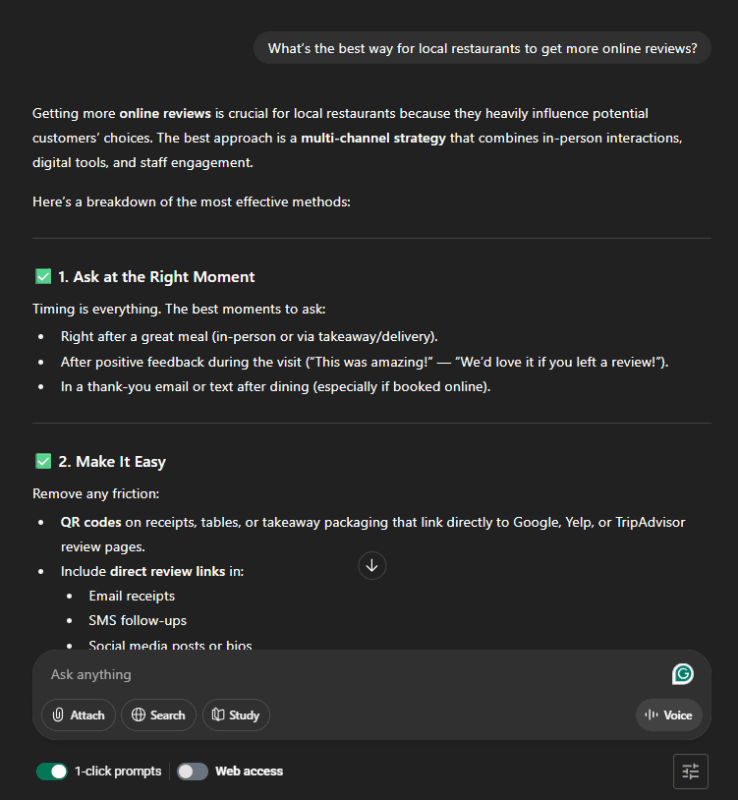
AI Models may not be perfect yet, so in this case, we go back to search engines to get absolute answers to queries
Pros and Cons
- Pros: It positions your brand at the forefront of AI-driven research, making you part of the conversation before a user even gets to a search results page.
- Cons: It’s very difficult to track and measure the impact. You don’t get a link or a direct citation, so measuring the ROI is a long-term brand-building exercise.
How to Rank Higher
- Create Original Research: Publish unique frameworks, data, or reports that no one else has.
- Build Authority Beyond Your Site: Get cited on reputable third-party sites like Wikipedia, major news outlets, and industry blogs.
- Use Author Tags: Ensure all content is tied to a specific, qualified author with a detailed bio. This boosts your E-E-A-T signals.
AIO: Building Digital Memory
AIO stands for AI Optimization. It’s the most strategic and long-term pillar. It’s about structuring your content and data so that AI models can easily read, understand, and store it for future use. This goes beyond search and into the core of how AI systems learn and build their knowledge graphs.
Core Principles of AIO
- Token Efficiency: AIO prioritizes the efficient use of tokens—the units of text LLMs use to process language. By reducing redundancy, you help ensure your content is interpreted precisely and economically by the AI.
- Embedding Relevance: LLMs convert text into high-dimensional vector representations called embeddings. AIO seeks to improve the semantic strength of these embeddings, increasing the likelihood that your content is matched to relevant user prompts.
- Contextual Authority: Content that demonstrates clear topical focus and internal consistency tends to be weighted more heavily in AI-generated outputs. AIO aims to strengthen this authority across vectorized knowledge graphs.
- Canonical Clarity: This principle encourages disambiguated phrasing and the use of canonical terms so that AI systems can accurately resolve meaning and avoid generating incorrect information.
The Major Difference: Unlike the other pillars which target a specific interaction (a click, an answer, or a citation), AIO focuses on data and long-term equity. It’s about ensuring your brand is consistently and accurately represented in the foundational knowledge that AI models use. Without AIO, you risk AI models generating incomplete or outdated information about your company.
Example Behavior: An AI system like Gemini pulls from structured databases to answer, “What is Boostability, and what services do they offer?” If your brand information is well-structured with schema, consistent naming, and published to data sources like Wikidata, the AI can deliver an accurate, branded response.
Pros and Cons
- Pros: It future-proofs your brand by embedding your presence directly into the learning models of the next generation of AI. AIO also contributes to AI safety by minimizing the risk of “hallucinations” or misattributions in high-stakes industries like healthcare and law.
- Cons: This is a very technical and long-term strategy with no immediate feedback. You may not see a direct return on your investment for years.
Read our Comprehensive Guide on AI Optimization
Key Takeaway: The Full-Spectrum Strategy
The future of search is not about choosing between SEO, AEO, GEO, AIO, or CRO—it’s about mastering them as an interconnected ecosystem. Each plays a unique role in the customer journey: SEO drives high-intent traffic, AEO captures zero-click visibility, GEO positions your brand as a trusted authority, AIO builds long-term equity, and CRO converts visitors into outcomes.
The brands that thrive will be the ones who see visibility as a Be Found Framework strategy, not a set of disconnected tactics. In a world where AI is reshaping how people discover and trust information, the winners will be those who build authority, deliver experiences, and embed themselves into both human and machine-driven discovery.
Partner With the SEO Leader
At Boostability, we’ve been helping businesses dominate search for over a decade, and we’re already leading the way in this new era of AI-powered discovery. From traditional SEO to advanced strategies in AEO, GEO, AIO, and CRO, we know how to turn visibility into measurable growth.
Ready to future-proof your digital presence? Partner with Boostability—the SEO leader trusted by thousands of businesses worldwide—to build a strategy that ensures your brand isn’t just found today, but remembered tomorrow.
Learn More About Boostability’s SEO Solutions. Get Free SEO Analysis to how your website ranks online, what keywords you rank for, how you stack up against your competitors, and what to do to optimize your website for better performance.