
Beyond the Click: Mastering the 10-Stage AI Search Pipeline

Search hasn’t disappeared – it’s evolved.
In 2026, ranking on Google is no longer the primary goal. The real advantage is being included in AI‑generated answers from platforms like ChatGPT, Claude, and Google Gemini. These systems do more than retrieve information – they verify it.
Before recommending a business, AI engines scan multiple sources across the web to answer one question:
“Is this brand trustworthy enough to include?”
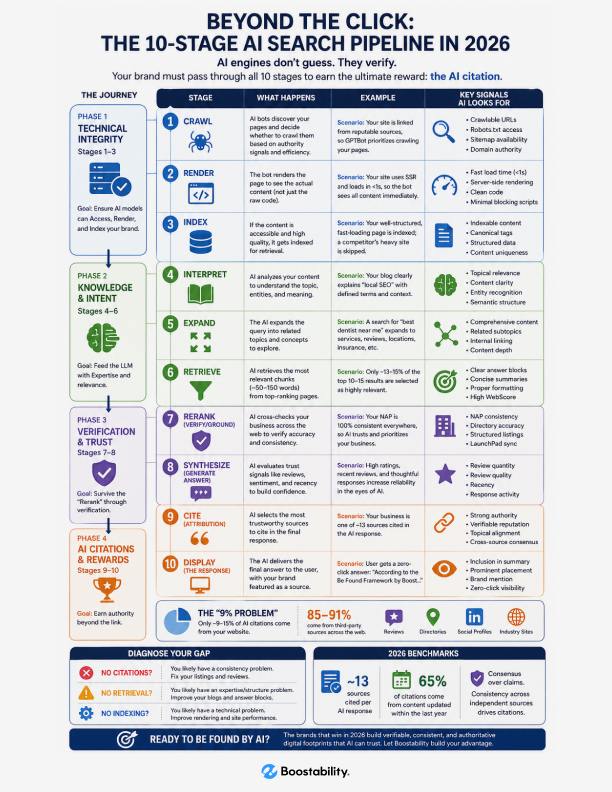
That evaluation happens through the 10‑Phase AI Search Pipeline. If your brand fails at any stage, visibility drops – even if your SEO fundamentals are strong.
Phase 1: Technical Integrity
If AI systems cannot access your content instantly, your expertise becomes invisible. The gap between being indexed and being ignored is now measured in milliseconds. Traditional SEO focuses on the human experience. Generative Engine Optimization (GEO) focuses on the Machine Experience.
The Execution Gap
Modern websites rely heavily on JavaScript. While this benefits human users, AI crawlers operate on a limited Discovery Budget. They will not wait for scripts to hydrate your content. Instead, they:
- Fetch the page
- Scan what is immediately visible
- Exit if the content is not fully rendered
The result: your content exists for humans but is a ghost to the machines that drive search.
The Solution: Server‑Side Rendering (SSR)
SSR is now essential. It delivers a fully rendered document the moment the crawler arrives.
Why it works:
- Zero Latency: AI models avoid spending compute rendering your UI.
- Immediate Grounding: Content is visible on first load, enabling faster verification.
The 3x Multiplier: Pages rendered in under one second earn significantly more AI citations because they reduce friction for the crawler.
How AI Interprets Your Site: A simple example
Type of Site
JS-heavy site
SSR optimized site
What AI Sees
Incomplete content
Full content instantly
Outcome
Skipped
Indexed
If you’re not indexed, you’re not even in the game.
Phase 2: Knowledge and Intent
Ranking gets you seen. Structure gets you cited.
Once your content is accessible, AI systems evaluate it for clarity, utility, and extractability. They break long articles into semantic chunks of 50–150 words. If your insights are buried in long introductions or vague phrasing, they fail the retrieval test.
The 15% Reality
For any query:
- AI reviews 10–15 top‑ranking pages
- Only ~13–15% get cited
Most “good” content is ignored because it is not structured for synthesis.
The Synthesis Test
AI cites content that reduces its own cognitive load.
Cited Content:
- Front‑loads value
- Uses declarative language
- Provides extractable facts
Ignored Content:
- Buries the lead
- Uses vague phrasing
- Requires interpretation
If the AI must interpret your meaning, it will skip you. If it can extract your meaning, it will cite you. Here is a cheat sheet.
| Cited Content (The Authority) | Ignored Content (The Noise) |
| Front-loads the value: Provides the “Answer Block” in the first 50 words. | Buries the lead: Forces the AI to “dig” through 300 words of intro. |
| Declarative Language: Uses “is,” “will,” and specific data points. | Vague Phrasing: Uses “may,” “could,” and generic industry jargon. |
| Zero Interpretation Required: The facts are ready for immediate synthesis. | High Cognitive Load: Requires the AI to “guess” the core sentiment. |
Example: Same idea, different outcome
Weak: “SEO has changed a lot over the years…”
Strong: “AI search engines prioritize brands that are consistently verified across multiple third-party sources.”
The second version is extractable. The first isn’t.
The Bottom Line: If the AI has to “interpret” your meaning, it will ignore you. If it can “extract” your meaning, it will cite you.
Phase 3: Verification
In the AI era, search is no longer about relevance alone. It is about verifiability.
When AI retrieves your content, it triggers a Verification Loop. It cross‑checks your claims against your Entity Fingerprint – your NAP data, directory listings, social profiles, and review sentiment.
AI systems look for a Consensus of Truth. Any inconsistency increases your “Hallucination Risk,” causing the AI to drop you in favor of a competitor with a unified footprint.
Why Consistency Wins
Consistency removes friction. It signals:
- Real‑world presence
- Operational reliability
- Low risk of misinformation
Tools like LaunchPad help maintain this unified footprint across hundreds of directories. Reviews also act as grounding signals. Responding to reviews demonstrates activity and accountability.
No response signals an inactive business. Consistent responses signal a reliable brand.
Phase 4: AI Citations
The New Competitive Landscape
AI systems synthesize answers using a small set of trusted sources. The average AI response cites roughly 13 unique sources.
You are no longer competing for Rank #1. You are competing for inclusion.
The 9% Problem
Only 9–15% of AI citations come from your website.
The remaining 85–91% come from third‑party sources:
- Directories
- Review platforms
- Social profiles
- Media mentions
This is the Distributed Trust Model. AI engines verify your claims by checking what the rest of the web says about you.
The Zero‑Click Mention
When your technical foundation, content structure, and off‑site consistency align, you earn a Zero Click Mention – where the AI cites your brand directly in its answer without requiring a user click.
This is the new standard of authority.
The Be Found Framework (BFF)
To earn citations in 2026, your content must pass the 3‑E Test:
- Easy to Scan: Use technical SSR Integrity so the AI can “map” your page in milliseconds.
- Easy to Extract: Use Intent-First “Answer Blocks”—modular, 50-word chunks that the AI can copy-paste into its synthesis engine without rewriting.
- Easy to Trust: Anchor your authority outside your website. Use LaunchPad for 100% consistency so that when the AI fact-checks you against the world, it finds a unified truth.
Boostability builds the infrastructure that ensures your brand is the most trusted, consistent, and reachable answer in the AI era.
Where Your Brand May Be Breaking
If your brand isn’t showing up in AI results, you have a leak in the pipeline. Use this diagnostic to find where you are losing your visibility:
No Indexing (Technical Break)
The Problem: The AI “Fetch” or “Render” failed.
The Fix: Implement Server-Side Rendering (SSR) and improve load speeds. If the bot can’t see your content in the first 500ms, it moves on.
No Retrieval (Content Break)
The Problem: Your content lacked clarity or modularity.
The Fix: Add Intent-First “Answer Blocks” and better structure. If the AI can’t “chunk” your expertise into a 50-word summary, it won’t retrieve it.
No Citations (The Trust Break)
The Problem: A lack of consistency or “Digital Provenance.”
The Fix: Align your NAP data via LaunchPad and strengthen your review signals. If the AI finds conflicting data across the web, it views you as a “Hallucination Risk” and skips you.
2026 Benchmarks to Know
- AI engines cite an average of 13 sources per answer.
- 65% of citations come from content or reviews updated within the last 12 months.
- Most citations come from third‑party platforms, not your website.
Final Thought: The New Standard of Search
In the old world of SEO, success was about volume. But that has changed. AI search isn’t about being the loudest anymore; it’s about being the most verifiable.
AI search rewards brands that are verifiable, consistent, and structured for synthesis. The AI Search Pipeline is an interrogation, not a retrieval. When an AI system evaluates your brand, it is looking for stable data it can trust.
The brands that win are those aligned with the Be Found Framework – consistent across platforms, structured for clarity, and supported by distributed trust signals.
Search hasn’t disappeared.
It is evolving. Don’t let your strategy end up in a museum next to the dial-up modems..
