
Google December 2025 Core Update: How SMBs can win the AI SEO game
On December 29, 2025, Google officially completed its third and final broad core update of the year. Rolling out over 18 days, this update wasn’t just a minor tweak—it was a structural recalibration of how Google defines “quality” in an AI-saturated world.
Whether you’ve seen a dip in traffic or a sudden surge, here is the definitive breakdown of what happened, what it means for your business, and how to dominate your local market in 2026.
What the December 2025 Update Changed
This update focused heavily on “Content Necessity.” Google’s systems are now significantly better at identifying whether a page provides a unique perspective or is simply “AI slop”—generic, repetitive content that summarizes existing search results without adding value.
- The “Experience” Multiplier: Within the E-E-A-T framework, Experience took center stage. Google is rewarding content that proves a human actually performed the service, tested the product, or visited the location.
- Intent Purity: Pages that try to be “everything for everyone” struggled. Google favored “intent-pure” pages—if a user wants information, give them a deep guide; if they want a service, give them a clear, fast-loading service page.
- Volatility Waves: Unlike some updates that hit all at once, this one saw massive spikes on December 13th and December 20th. If your rankings shifted during these windows, your site was directly in the crosshairs of this recalibration.
What This Means for Your Business
If you are a local service provider—a law firm, dental clinic, architect, or plumber—the “old way” of SEO (buying backlinks and keyword-stuffing blog posts) is officially a liability.
- Trust is Your New Currency: Sites without clear author bios, physical addresses, and verified credentials saw visibility drops of up to 60% in some niches.
- Zero-Click Reality: With the integration of Gemini 3 into Search, more users are getting answers directly on the search page. To win, you must be the “Source of Truth” that the AI cites.
- Local Authority over Global Volume: Google is prioritizing businesses that prove they are deeply rooted in their specific service areas.
For local service industries—whether you are a plumber, a dentist, an architect, or a law firm—the December 2025 Core Update signals a move away from “keyword stuffing” and toward “Real-World Proof.”
Google’s AI is now better at verifying if you actually exist, if you are actually in the neighborhood you claim, and if customers actually like you.
Using the Be Found Framework for 2026 Core Update Recovery
Phase 1: The “Identity” Audit (Weeks 1–2)
Google is prioritizing businesses with a clear, consistent digital footprint.
- Google Business Profile (GBP) Deep-Clean: Ensure your Name, Address, and Phone (NAP) are identical across your website, GBP, and Yelp/local directories.
- Verify Your Categories: Check if your primary category still best represents your service. (e.g., A law firm should ensure they aren’t just listed as “Lawyer” if they specialize in “Personal Injury Law”).
- Visual Proof: Google’s AI now “reads” images to verify locations. Upload 3–5 new, high-resolution photos of your branded vehicles, your physical office, and your team in action at local landmarks.
Phase 2: Content “Humanization” (Weeks 3–5)
The era of generic, AI-written “Top 5 Tips for [Service]” is over. Google wants Experience.
- Add Author Bylines: Every blog post should have a real person’s name and bio. (e.g., “Written by Dr. Aris, Dental Surgeon with 15 years of experience in [City Name].”)
- Case Studies over “Tips”: Instead of “How to fix a leak,” write “How we fixed a 50-year-old pipe system in the [Neighborhood Name] district.” Include a photo of the job.
- Neighborhood-Specific Pages: If you serve multiple areas, create unique landing pages for each. Don’t just swap the city name—mention local landmarks, common local issues (e.g., “Hard water issues in Westside”), and local testimonials.
Phase 3: The Reputation Engine (Ongoing)
Reviews are now being “scanned” for sentiment and keywords by Google’s AI.
- Quality over Quantity: A 5-star review that says “Great!” is less valuable than a 4-star review that says “The plumber fixed my burst pipe in [City] and was very professional.”
- The “Ask”: Encourage customers to mention the specific service and neighborhood in their review.
- Response Speed: Aim to respond to all reviews (positive and negative) within 48 hours. This signals to Google that you are an active, trustworthy business.
Phase 4: Preparing for 2026 AI Search
As users start using AI (like Gemini) to find services, you need to be “summarizable.”
- Implement “LocalBusiness” Schema: This is a snippet of code that tells AI exactly what your hours, services, and prices are.
- Short FAQ Sections: Add a “Frequently Asked Questions” section to your service pages. Use natural, conversational language like “Do you offer emergency plumbing on Sundays in [City]?”
- Video Snippets: Upload 30-second “Explainer” videos to your site and GBP. AI can now parse video content to understand your expertise.
Your 2026 Monthly Checklist

A simple maintenance schedule to keep your small business competitive after the December 2025 Google Core Update.
How to Rank in AI Overviews
To help you rank in the “AI Overviews” and voice searches of 2026, your FAQ shouldn’t just be a list of answers—it needs to be structured so Google’s “Core Systems” can easily extract the data.
Below are the Top 5 Local FAQ categories that apply to almost any service industry. You can customize the bracketed information for your specific business.
1. The “Immediate Need” FAQ
Targeting: Users in an emergency or high-intent phase.
- Question: Do you offer [emergency/same-day] services in [City/Neighborhood]?
- Answer: Yes, we provide [same-day/24-hour] [Service Name] to all residents in [City] and surrounding areas like [Neighborhood A] and [Neighborhood B]. Contact us at [Phone Number] for immediate dispatch.
2. The “Transparency & Trust” FAQ
Targeting: E-E-A-T (Experience and Trustworthiness).
- Question: Are your [plumbers/dentists/architects] licensed and insured in [State]?
- Answer: Absolutely. All our professionals are fully licensed, bonded, and insured to operate in [State]. We have been serving the [City] community for [Number] years and maintain a [mention specific award or rating, e.g., A+ BBB rating].
3. The “Pricing & Estimates” FAQ
Targeting: Reducing friction for the customer.
- Question: How much does a [Standard Service, e.g., initial consultation/pipe repair] cost in [City]?
- Answer: While every project is unique, our [Service] typically starts at $[Price]. We provide a transparent, written estimate before any work begins. We also offer [Financing/Senior Discounts/First-time Customer Specials] for local residents.
4. The “Process” FAQ
Targeting: User experience and clarity.
- Question: What should I expect during my first [appointment/site visit]?
- Answer: During your first visit, our [Professional] will [Action 1: e.g., conduct a full diagnostic], [Action 2: e.g., explain the blueprints], and provide you with a [deliverable: e.g., detailed quote or treatment plan]. This usually takes about [Time, e.g., 45 minutes].
5. The “Local Expertise” FAQ
Targeting: “Localness” signals for the December 2025 Update.
- Question: Are you familiar with [City]-specific building codes or climate issues?
- Answer: Yes, we specialize in [Service] tailored for [City]’s [Climate/Architecture]. For example, we frequently help [Neighborhood] homeowners deal with [Local Problem, e.g., clay soil foundations or winter pipe freezing], ensuring all work meets [City Name] municipal codes.
6. Strategic Local FAQ Implementation
This is your secret weapon for 2026. Use the following categories to capture “voice search” and “AI Overview” traffic:
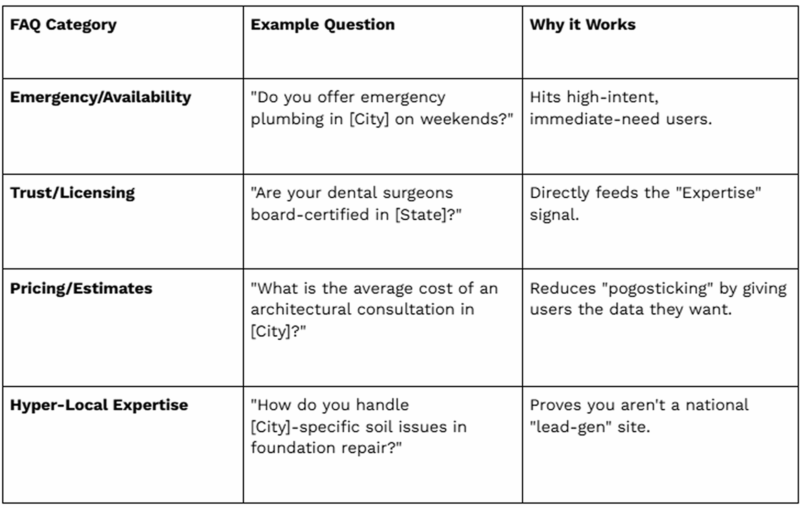
Strategic FAQ examples that help SMBs signal expertise and local relevance to AI search engines.
Pro-Tip: Make it “Machine Readable”
To get the most out of these FAQs, you should apply FAQ Schema Markup. This is a hidden layer of code that tells Google, “This is a question, and this is the answer.” When done correctly, your questions can appear directly in the Google search results, taking up more “real estate” and pushing competitors down.
What to Expect in 2026
The trend for the coming year is clear: Search is becoming an “Answer Engine.”
- More Frequent Updates: Google hinted at “more updates, more often.” Expect smaller, unconfirmed refreshes to happen monthly.
- AI Overview Integration: Your content will increasingly be used to power AI-generated answers. To stay relevant, use Structured Data (Schema) so Google can easily parse your facts.
- Conversational SEO: People are asking longer, more complex questions. Optimize for “how-to” and “why” queries rather than just single keywords.
Should you be concerned? Only if you are relying on old SEO “hacks.” If your business focuses on being the most helpful resource in your niche, these updates are actually designed to help you win in the long run.
Don’t Navigate the Update Alone
Google’s algorithms change over 1,000 times a year, and keeping up can be a full-time job. If you’ve seen a drop in rankings or simply want to ensure your business is “AI-ready” for 2026, it’s time to call in the experts.
Boostability is the global leader in small business SEO. They specialize in helping local businesses like yours navigate core updates, build local authority, and get found by the right customers. Get a Free Website Audit to know how your website is performing online
Ready to see where your site stands? Get a Free SEO Consultation today and let their experts build a data-driven recovery plan for your business.
