
How to Tell if an Image is AI-Generated And Why It Matters
A Real-World Scenario: The Perfect Product That Wasn’t
Imagine scrolling through your social media feed. A stunning ad pops up: a sleek, futuristic gadget, perhaps a new type of smart home device, perfectly rendered in a minimalist, dream-like setting. The lighting is flawless, the details impeccable, and the product looks utterly revolutionary. You click, you’re intrigued, and you might even consider purchasing it.
Now, imagine later discovering that the product doesn’t quite live up to the image. The device itself is clunkier, the materials cheaper, and it lacks the effortless elegance portrayed in the ad. Worse, you find out that every single image in the campaign was entirely AI-generated – a perfect digital fabrication that bears little resemblance to the real-world item.
This isn’t a hypothetical future; it’s a growing reality. Artificial Intelligence has profoundly changed the way we create and consume visual content. Tools like MidJourney, DALL·E, and Stable Diffusion can produce stunningly realistic images in seconds, democratizing image creation and offering unparalleled creative possibilities. While this technology is undeniably powerful and exciting, it also brings a new set of challenges for marketers, business owners, and consumers alike.
The big question on everyone’s mind is: How can you tell if an image is AI-generated?
And perhaps even more importantly, why does it truly matter for your brand and your online presence?
Why Detecting AI-Generated Images Matters
The rise of sophisticated AI image generation has blurred the lines between reality and simulation, creating new avenues for both innovation and deception. Understanding the implications of AI-generated imagery is crucial for everyone navigating the digital landscape.
For Consumers, the Concern is Clear:
- Avoid Scams and Fake Products: AI can be used to create highly convincing fake product images, leading consumers to purchase non-existent or inferior goods. The scenario above is a prime example: seeing an ad for a seemingly perfect, incredibly cheap new gadget, only to realize later the product images were entirely AI-generated and the company is a sham.
- Identify Misleading Ads or Fake Reviews: AI can generate realistic images of “satisfied customers” or “amazing results” that are entirely fabricated. This can manipulate purchasing decisions and erode trust in legitimate businesses. For example, a restaurant might post glowing reviews accompanied by AI-generated images of delicious-looking dishes and happy diners, when in reality, their food or service is subpar.
- Protect Yourself from Misinformation and Deepfakes: Perhaps the most alarming concern is the use of AI to create “deepfakes” – hyper-realistic manipulated images or videos that depict individuals saying or doing things they never did. This can be used to spread false narratives, damage reputations, or even influence political discourse.
For Marketers and Businesses, the Stakes Are Even Higher:
- Maintain Brand Trust: In an age where authenticity is paramount, customers expect transparency and genuine content from the brands they support. Undisclosed use of AI-generated images, especially those that misrepresent a product or service, can severely hurt credibility and lead to a perception of deception. If a customer discovers that the “real” people featured in your ad campaign are actually AI creations, or that your product was exaggerated with AI, it can lead to a feeling of betrayal and significantly diminish their trust in your brand.
- Stay Compliant: Regulatory bodies worldwide, such as the Federal Trade Commission (FTC) in the US, are actively exploring and introducing disclosure guidelines for AI-generated content. Failure to comply with these regulations can result in hefty fines and legal repercussions. For instance, if the FTC mandates clear labeling of AI-generated marketing materials, businesses that fail to adhere could face significant penalties.
- Protect Campaign Integrity: When working with influencers, user-generated content, or even stock photography, it’s crucial to ensure the visuals are authentic. Integrating AI-generated content unknowingly into your campaigns can dilute the message, mislead your audience, and even lead to backlash if discovered. Imagine running an influencer campaign where one of your key influencers uses AI-generated images to represent their lifestyle or product usage – this could quickly unravel the authenticity of your entire campaign.
Real-World Legal Implications and Examples
The promises and pitfalls of AI are already playing out in courtrooms. Businesses leveraging AI, particularly for marketing and product representation, are facing significant legal challenges. These cases underscore that while AI offers powerful tools, the responsibility for its ethical and lawful use remains firmly with the humans and businesses deploying it.
Misrepresentation of Product Capabilities / False Advertising:
- AccessiBe (Web Accessibility AI Tool): In April 2025, the Federal Trade Commission (FTC) required AccessiBe to pay $1 million to settle allegations that it misrepresented the ability of its AI-powered web accessibility tool. The company had claimed its AI could make any website compliant with Web Content Accessibility Guidelines (WCAG) for people with disabilities. The FTC found these claims were false, misleading, or unsubstantiated, despite the product often failing to address accessibility barriers. This is a clear precedent for businesses exaggerating AI capabilities.
- DoNotPay (“Robot Lawyer”): The FTC also took action against DoNotPay, which marketed itself as “the world’s first robot lawyer.” The company claimed its AI service could “sue for assault without a lawyer” and “generate perfectly valid legal documents in no time.” The FTC alleged these claims were false or misleading, as the product often failed to live up to its promises. DoNotPay settled with a fine and a requirement to notify customers about the limitations of its legal-related features.
- Pieces (Healthcare AI Research Firm): The Texas Attorney General’s Office settled with Pieces, a healthcare AI firm, over allegations it made false and misleading claims about the accuracy of its healthcare AI products. Pieces had advertised its generative AI products as “highly accurate” with “minimal hallucinations,” despite the potential for inaccurate outputs to harm patients. This highlights the risk of misrepresenting the reliability and safety of AI in critical sectors like healthcare.
- Apple (iPhone 16 AI features): Apple is currently facing multiple class-action lawsuits accusing it of misrepresenting AI features on the iPhone 16. Plaintiffs allege that Apple promoted a host of AI capabilities that were not fully ready or integrated at the time of the phone’s release, leading consumers to overpay for unfulfilled promises. While not solely about AI-generated images, this case is a strong example of how the promise of AI can lead to claims of consumer deception in advertising and marketing.
Copyright Infringement & Data Scraping (Impacting Content Integrity):
These cases focus not on the misleading nature of AI output, but on the legality of how AI models are trained, which directly impacts the originality and ethical sourcing of AI-generated content.
- Getty Images vs. Stability AI: Getty Images is actively suing Stability AI (creator of the Stable Diffusion image generator) for copyright infringement. Getty alleges that Stability AI used millions of its copyrighted images to train its AI model without permission, and that the AI’s outputs sometimes even reproduce distorted versions of Getty’s watermarks. The trial began in June 2025 in the UK and is a landmark case for how existing intellectual property laws apply to generative AI systems.
- Visual Artists vs. Stability AI, Midjourney, and DeviantArt: A group of visual artists filed a class-action lawsuit against these AI image generator companies, alleging direct and induced copyright infringement. They claim their copyrighted artwork was used without permission to train the AI models, and that the AI-generated images are infringing derivative works. A significant ruling in August 2024 allowed many of these claims to proceed, emphasizing that AI software “built to a significant extent on copyrighted works” could be facilitating infringement by design.
- The New York Times vs. OpenAI and Microsoft: The New York Times sued OpenAI and Microsoft in December 2023, alleging that these companies used millions of the Times’ copyrighted news articles to train their large language models (LLMs) like ChatGPT, without licensing. They argue that the AI models can then reproduce or summarize their copyrighted content, impacting their business.
- Music Publishers vs. Anthropic: Music publishers (including Universal Music, ABKCO, and Concord Publishing) have sued Anthropic (creator of the Claude LLM) for copyright infringement, alleging the AI used copyrighted song lyrics to train its models and can generate output containing those lyrics. While an injunction request was denied in March 2025, the underlying legal battle over copyright infringement in AI training continues.
- Voice Actors vs. Lovo / Scarlett Johansson vs. OpenAI: Voice actors have sued AI startup Lovo for allegedly replicating their voices without permission for its AI voiceover technology. Similarly, Scarlett Johansson publicly challenged OpenAI, alleging the company copied and imitated her voice for their new AI voice assistant, “Sky,” after she declined to license her voice to them. OpenAI subsequently removed the “Sky” voice. These cases highlight the emerging legal landscape around AI’s appropriation of human likenesses and creative works beyond just visuals.
These real-world examples serve as stark reminders: simply because AI can create something, doesn’t mean it should be used without scrutiny or proper authorization. The responsibility for AI-generated content always falls on the human or business that uses and publishes it. “The AI did it” is not a valid legal defense when it comes to misrepresentation or intellectual property infringement.
5 Signs an Image Might Be AI-Generated
AI image generation has advanced remarkably, yet even the most sophisticated models still leave subtle, and sometimes not-so-subtle, clues. Here’s what to look for when trying to discern if an image is AI-generated:
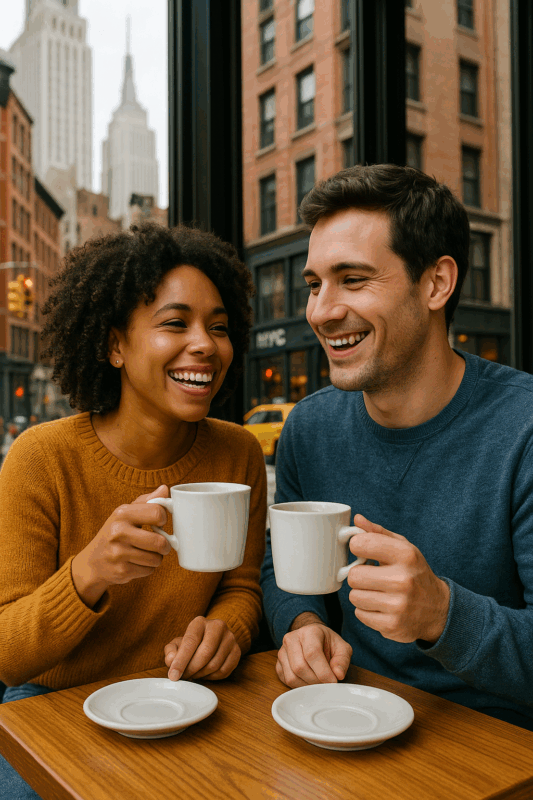
AI Prompt from ChatGPT – 4o: happy couple drinking coffee in a coffee shop in NYC
1. Weird Hands & Fingers
This is arguably the most common and persistent tell-tale sign of an AI-generated image. AI still struggles with accurately rendering human hands and fingers.
- Examples to look for:
- Extra Fingers or Too Few Fingers: A person with six fingers on one hand, or a thumb that looks like another finger.
- Strange Bending or Unnatural Poses: Fingers bending in impossible ways, or hands contorted into bizarre, uncomfortable positions.
- Mismatched Hand Sizes: One hand appearing significantly larger or smaller than the other.
- Missing or Blurry Nails/Knuckles: Details like fingernails or knuckles might be completely absent, or appear smudged and indistinct.
- Best Practices to Avoid (for AI users):
- Focus on torso/head shots: If you are generating AI images for your business, try to frame your shots to minimize the visibility of hands.
- Prompt with “perfect hands” or “realistic hands”: While not foolproof, adding specific descriptors for hands in your prompts can sometimes yield better results.
- Manual Touch-Ups: For critical images, consider using image editing software to manually correct any hand anomalies.
2. Inconsistent Shadows & Lighting
AI can sometimes create visually appealing scenes, but its understanding of real-world physics, especially light and shadow, can be flawed.
- Examples to look for:
- Shadows that Don’t Align with the Light Source: A person standing in front of a bright window, but their shadow is cast as if the light source is from the side.
- Oddly Uniform or Flat Lighting: The lighting in the image might appear unnaturally even, lacking the natural variations and depth that real-world lighting creates.
- Objects Lit from Multiple, Undefined Sources: Different parts of the image appearing to be lit from different, non-existent light sources.
- Reflections that Don’t Make Sense: Reflections in water or shiny surfaces that don’t accurately mirror the surrounding environment.
- Best Practices to Avoid (for AI users):
- Use descriptive lighting prompts: Specify the type and direction of light (e.g., “golden hour light,” “harsh overhead light,” “soft diffused light from the left”).
- Generate multiple variations: AI models can sometimes produce better lighting in subsequent attempts.
- Analyze and refine: If you notice lighting inconsistencies, try to regenerate the image with more specific lighting instructions or consider minor edits.
3. Overly Perfect Faces
Real humans have imperfections – pores, slight asymmetry, subtle wrinkles, and unique facial features. AI often struggles to replicate this natural variability.
- Examples to look for:
- Flawless, Almost Plastic-Like Skin: A complexion that is unnaturally smooth and devoid of any pores, blemishes, or natural skin texture.
- Symmetrical to an Uncanny Degree: While human faces have a degree of symmetry, AI can produce faces that are almost perfectly mirrored, which looks unnatural.
- Lack of Subtle Imperfections: No slight freckles, moles, or natural variations in skin tone that are characteristic of human skin.
- Uncanny Valley Effect: The face might look almost real, but something about it feels “off” or unsettling, often due to this over-perfection.
- Best Practices to Avoid (for AI users):
- Prompt for “realistic skin texture” or “natural imperfections”: Encourage the AI to add subtle human elements.
- Vary facial expressions: Avoid consistently generating neutral or overly posed faces.
- Consider using human models: For close-up facial shots where authenticity is crucial, actual human models are often the best choice.
4. Strange Background Details
While the main subject of an AI-generated image might be convincing, the background can often reveal its artificial origins.
- Examples to look for:
- Warped or Distorted Objects: Buildings, trees, or objects in the background might appear stretched, squashed, or strangely proportioned.
- Nonsensical Structures: Background elements that don’t seem to have a logical purpose or architectural sense (e.g., a building with windows in impossible places).
- Repeated Patterns or Textures: The AI might struggle with generating diverse background elements, leading to repetitive or tiled patterns.
- Blurring or Smudging Where It Shouldn’t Be: Parts of the background might be unnaturally blurred or smudged, especially around the edges of objects.
- Best Practices to Avoid (for AI users):
- Provide clear background descriptions: Specify the environment in detail (e.g., “bustling city street,” “serene forest,” “modern office interior”).
- Use negative prompts: Exclude undesirable elements (e.g., “no blurry background,” “no distorted objects”).
- Evaluate the entire image: Don’t just focus on the subject; scrutinize the background carefully for any inconsistencies.
5. Messy or Nonsensical Text
Text within AI-generated images is a notoriously difficult challenge for current models. Logos, signs, words on clothing, or any printed text often appear jumbled, unreadable, or nonsensical.
- Examples to look for:
- Gibberish or Unidentifiable Characters: Letters that are not part of any known alphabet, or a string of characters that makes no sense.
- Incorrect Spelling or Grammar: Even if recognizable, words might be misspelled or sentences grammatically incorrect.
- Warped or Distorted Text: Letters that are stretched, squashed, or appear to melt into each other.
- Logos or Brands that are “Almost But Not Quite”: A logo that resembles a well-known brand but has subtle, incorrect alterations.
- Best Practices to Avoid (for AI users):
- Avoid including text in your prompts if possible: If text is not essential, omit it.
- Overlay text manually: For any image requiring clear, legible text (e.g., product labels, signs), generate the image without text and then use graphic design software to add the text separately.
- Keep text minimal and simple: If you must have text, try to use short, clear words or numbers.
Tools You Can Use to Detect AI Images
As AI image generation becomes more sophisticated, so do the tools designed to detect it. Here are some resources you can use:
Free Tools
- Hugging Face AI Detector: A popular and easily accessible online tool where you can upload an image and get an assessment of its likelihood of being AI-generated. It’s a quick and easy way to get a preliminary check.
- Illuminarty: This tool is designed to detect synthetic and manipulated media. It provides a more detailed analysis, sometimes highlighting specific areas of an image that might indicate AI generation or manipulation.
- Google Reverse Image Search: While not specifically an AI detector, Google Reverse Image Search can be incredibly useful. By uploading an image, you can see if it appears elsewhere online. If an image you suspect is AI-generated appears on multiple, disparate, or suspicious websites, it could be a red flag. It can also help you identify the original source of an image, which can be crucial for verification.
- AI or Not (by Astria): Another user-friendly online tool that allows you to upload an image and get a quick determination on whether it’s likely AI-generated or human-made.
Pro Tools for Businesses
- Hive Moderation: For businesses dealing with large volumes of content, Hive Moderation offers enterprise-level content authenticity verification. Their AI-powered platform can quickly analyze and flag various types of problematic content, including AI-generated images, ensuring brand safety and compliance.
- AI Watermark Detectors: Major players like OpenAI and Google are actively developing and implementing watermarking technologies designed to identify AI-generated content. These watermarks, often imperceptible to the human eye, will be embedded in images at the point of creation, making them easily verifiable. As these become standard, dedicated detectors will emerge.
For Marketers: How to Use AI Effectively and Honestly
AI is an incredibly powerful creative tool, but its effective and ethical deployment in marketing requires a thoughtful and strategic approach. The key is to leverage AI’s strengths while upholding your brand’s integrity and ensuring transparency.
- Disclose AI-Generated Content: Transparency is the cornerstone of building and maintaining customer trust. Whenever you use AI-generated images in your marketing, clearly disclose it. This could be a small disclaimer next to the image, a specific icon, or a note in the caption. For example, for a blog post featuring an AI-generated hero image, you might add a small note: “Image generated with AI.” For a social media campaign, a hashtag like #AIGenerated or #AICreated can be used. This not only builds trust but also keeps you compliant with evolving regulations.
Warning: Do not use AI to misrepresent your product, service, or customer experience. Exaggeration through AI, especially if it creates a false impression of what you offer, is a sure path to losing customer trust and facing regulatory scrutiny. - Blend AI & Human Creativity: View AI as an enhancer, not a complete replacement. Use AI for inspiration, generating initial concepts, or scaling content production where human involvement would be too time-consuming or costly. For instance, an AI can generate hundreds of variations of a product shot for A/B testing, but the final, high-stakes campaign image might still be a professionally shot photograph of the actual product. Leverage AI for background generation, conceptual art, or even image upscale, while retaining human oversight for key creative decisions and ensuring brand voice and values are maintained.
- Stay Ahead of Trends: The landscape of AI is evolving at an unprecedented pace. New regulations, watermarking standards, and detection algorithms are constantly being developed. Subscribe to industry newsletters, follow AI ethics and marketing publications, and attend webinars to stay informed. Proactively adapt your content strategy to incorporate new best practices and technological advancements. This includes understanding the latest updates from platforms like Google regarding AI-generated content in search results.
For Consumers: How to Stay Safe
As consumers, becoming more discerning about the images you encounter online is a critical skill in the digital age.
- Question “Too Perfect” Images: Develop a healthy skepticism. If an image looks incredibly polished, flawless, and almost too good to be true, it might be. Consider if the lighting, skin texture, or overall composition seems unnaturally perfect. For example, an influencer’s travel photo featuring an impossibly pristine, empty beach at a popular tourist spot might be a red flag.
- Check Sources: Always consider the source of the image. Is it from a reputable news organization, a verified brand account, or a well-known individual? Be wary of images shared by unverified accounts, suspicious websites, or through chain messages. Cross-referencing information and images with multiple trusted sources is always a good practice.
- Use Detection Tools: When in doubt, leverage the free AI detection tools mentioned earlier. They are quick, easy to use, and can provide a valuable second opinion. Before you share an image, make a purchase based on an image, or believe a piece of visual information, take a moment to verify its authenticity.
The Future of AI Image Detection
The arms race between AI generation and AI detection is ongoing. As AI models become more sophisticated, so will the methods of identifying their output.
- AI Watermarking: This will likely become the standard. Invisible digital watermarks will be embedded into AI-generated visuals at the point of creation. These watermarks will contain metadata that clearly identifies the image as AI-generated and potentially even the AI model used. Platforms like social media and search engines will then be able to read these watermarks, allowing for automated disclosure and filtering.
- Blockchain Authentication: Expect brands to increasingly explore blockchain-based solutions for image verification. By registering original images on a blockchain, companies can create an immutable record of authenticity, making it easier to prove that a particular image is genuine and has not been tampered with or AI-generated. This could be particularly valuable for e-commerce, product photography, and sensitive corporate communications.
- Stronger Detection Algorithms: Social media platforms, search engines, and content moderation services will continue to integrate more advanced AI detection features directly into their systems. These algorithms will become more adept at spotting the subtle tells that current AI models leave behind, even as the models themselves improve. This will enable faster and more accurate identification of AI-generated content at scale.
Why This Matters for Your Brand Strategy: SEO and Reaching the Right Audiences
The evolving landscape of AI-generated content is not just a technological curiosity; it’s a fundamental shift that demands a proactive response from every business. Ignoring the implications of AI image generation and detection is no longer an option.
Whether you choose to embrace AI in your marketing efforts or primarily focus on safeguarding your brand against fake content risks, understanding AI image detection is absolutely essential for:
- SEO is Still Paramount: Despite the buzz around AI image generation, your fundamental SEO strategy remains the bedrock of your online presence. High-quality, helpful content that directly addresses user intent, optimized with relevant keywords and structured for readability, will always be favored by search engines. AI images can enhance your content visually, but they cannot replace a solid SEO foundation. It is still best to focus on SEO in content creation and follow best practices so you can reach out to the right audiences effectively.
- Reaching the Right Audiences for Your Goals: Effective SEO ensures that your content, whether it contains AI-generated images or not, is discovered by the people who are genuinely interested in your products or services. It is very important that the right audiences are reached so that you can focus on the goal of your product. If your AI-enhanced content isn’t optimized for search, it won’t matter how visually stunning it is – it simply won’t be seen by those who matter most to your business objectives.
- Brand Trust: In a world awash with digital imagery, authenticity is a rare and highly valued commodity. Proactively managing your AI content strategy and ensuring transparency will differentiate your brand and foster deeper trust with your audience. This trust, built on genuine connection and accurate representation, is invaluable for long-term customer loyalty.
- Online Visibility: As platforms integrate more robust detection tools, images that are improperly labeled or deemed misleading might face reduced reach or even removal. Staying ahead of these changes ensures your content remains visible and compliant, securing your online presence.
The digital world is evolving at an unprecedented pace – and your brand strategy should too.
Need Help Navigating AI in Marketing?
Boostability understands the complexities and opportunities that AI presents for businesses. We help brands craft strategies that balance innovation with authenticity, ensuring you can leverage the power of AI while safeguarding your reputation. Whether you want to responsibly integrate AI for better content creation, ensure your marketing campaigns are trustworthy and compliant, or simply understand how to protect your brand from the risks of synthetic media, we’ve got you covered.
Do you want to know how your website ranks online, what keywords you rank for, how you stack up against your competitors? Get a Free Website Analysis and learn how to optimize your website for better performance.
📞 Contact us today and let’s create a future-ready strategy tailored to your brand.
