
Be Found Framework (BFF): How Businesses Win in the AI Search Era
Artificial intelligence is transforming how people look for information, make decisions, and buy products. Search is no longer a single experience confined to Google’s ten blue links. It’s now an ecosystem of AI-generated answers, chat interfaces, voice prompts, and recommendation engines that accompany users from the moment a question forms to the instant a purchase is made.
For more than a decade, SEO has been about optimizing content to appear on Google’s first page. And for good reason, Google has been the primary place people go to get answers. That goal still matters; Google is still the front page of the internet. But Google is changing, and the internet is changing with AI.
In today’s environment, visibility also means being cited in AI Overviews, mentioned by large-language models (LLMs) like ChatGPT and Claude, and accurately represented across local listings, shopping feeds, and social platforms.
Boostability’s Be Found Framework (BFF) was created to help businesses thrive in this new landscape. BFF unifies the disciplines of traditional SEO with emerging practices in generative and AI optimization, offering a single framework for visibility, trust, and measurable growth.
The New Search Reality
The landscape of digital visibility is undergoing one of the most profound shifts since the birth of search engines. The era of traditional SEO, while still foundational, is no longer the singular pathway to growth. As artificial intelligence weaves itself deeper into search engines, content discovery, and user interactions, search behavior now flows through three distinct but overlapping channels.
1. Generative AI platforms
People increasingly start their research with tools like ChatGPT, Gemini, Claude, or Perplexity. These assistants synthesize information across the web, presenting concise, conversational answers. Studies show that informational and exploratory searches—“how,” “why,” and “compare” queries—are moving rapidly into this space. Consumers use these tools for ideation, problem-solving, and early learning long before they reach a brand’s website.
2. AI-driven search experiences
Google’s AI Overviews (and the emerging AI Mode) now appear on more than 10% of all queries, according to BrightEdge research, and that share is growing. Google reports that more than 1.5 billion people encounter these AI summaries every month. AI Overviews are heavily skewed toward informational intent; they condense multiple perspectives into one answer, often satisfying the user without a click. This is the foundation of the “zero-click” era—over half of all searches end on the search results page itself, never clicking to a website.
3. Classic Google Search
Despite all the disruption, traditional search results still drive the majority of commercial, navigational, and transactional activity. When users are ready to compare products, check availability, or contact a provider, they turn to standard listings, local packs, shopping modules, and review panels. Google remains the gateway for revenue-driving search behavior, even as AI changes how users arrive there.
In other words, AI is taking over the research layer, but Google remains the place people go after they know what they want.
Introducing the Be Found Framework
The challenge for businesses today is that visibility in this new world is no longer limited to rankings. It’s now distributed across multiple search and query experiences, which means brand visibility requires a confluence of multiple optimization strategies. The Be Found Framework (BFF) is Boostability’s design at layered optimization for maximum visibility in the AI age. It connects five interconnected disciplines—SEO, SXO, AEO, GEO, and AIO—to ensure that your brand is seen, trusted, and chosen wherever people search.
Search Engine Optimization (SEO)
SEO remains the backbone of digital visibility. It focuses on the technical health of your website, content relevance, and authority through link building. As search engines advanced, SEO became about clarity of entities—defining who you are, what you offer, and how your expertise connects to recognized topics across the web. It’s also a popularity strategy, where links act like popularity votes, and help search engines understand that your site is more popular than others that are also relevant to the search queries.
Search Experience Optimization (SXO)
As traffic engagement and bounce rates began correlating more strongly with search rankings, post-click optimizations became a key tenet of SEO strategies. The search experience has seen a resurgence with the rise of AI-driven search. Visibility is only half the story, SXO makes sure every impression counts, turning clicks, mentions, and citations into measurable engagement.
The key to SXO is understanding and addressing user intent. A visitor coming from an informational query might need education or a downloadable guide, while someone searching for “best local SEO provider near me” expects pricing or contact options. SXO is the process of building the right type of pages on your website to satisfy the intent of the searcher, it could also mean building pages for AI LLMs.
Answer Engine Optimization (AEO)
AEO is about earning a voice inside AI-generated answers. Google’s AI Overviews and voice assistants pull information from sources they consider trustworthy and well-structured.
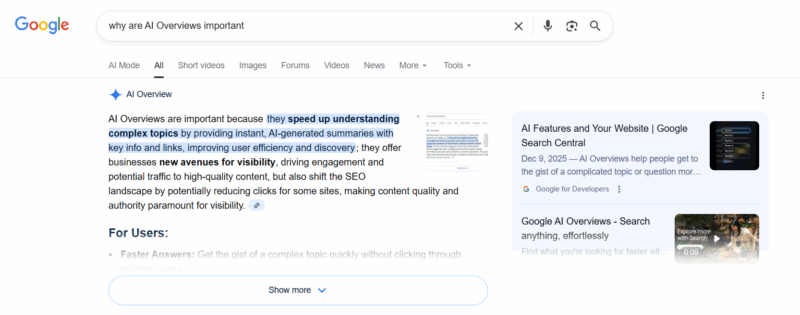
A screenshot example of an AI Overview search query answer
Content optimized for AEO is concise, factual, and verifiable. It anticipates the exact questions people ask, provides short authoritative answers, and supports them with credible references.
New content formats like “Chunking” allow you to give quick and concise answers. Think of it as writing for the “answer layer” of search. Clear formatting using headings, tables, step lists, and schema, help algorithms understand context, while transparent sourcing demonstrates expertise. AEO ensures your brand doesn’t just appear below the fold. It's part of the answer itself.
Generative Engine Optimization (GEO)
Generative Engine Optimization is moving beyond Google’s search experience. LLMs such as ChatGPT, Claude, and Perplexity pull from vast datasets to construct their responses. The goal is to become a trusted source or reference point for LLM outputs. To be cited, brands must publish content that LLMs recognize as reliable, which means delivering clarity, structure, and authority.
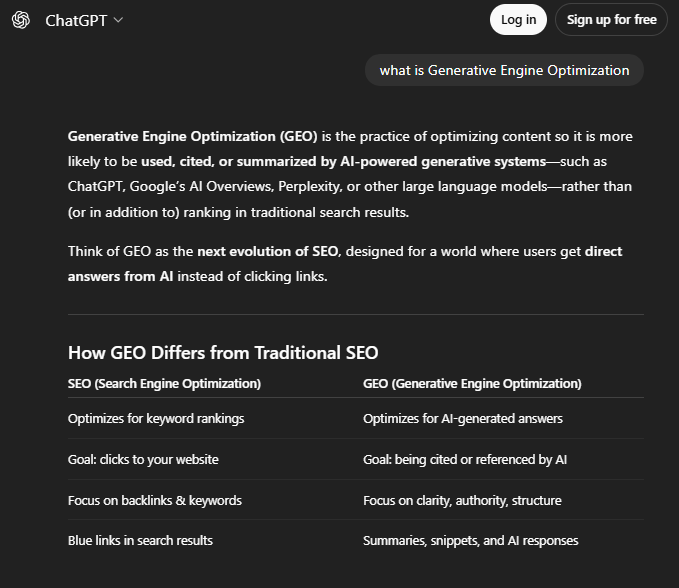
This screenshot from ChatGPT defines Generative Engine Optimization (GEO) as the next evolution of SEO, designed for a world where users get direct answers from AI. The table outlines key differences between optimizing for traditional search engines versus AI-powered generative systems.
Pages that define key terms, outline frameworks, present original data, or provide evergreen educational material are particularly valuable. These assets signal to AI models that your business is a credible source worth quoting.
AI Interaction Optimization (AIO)
The final layer of BFF prepares your business for the moment when AI doesn’t just answer questions but takes action.
As Google and other platforms introduce agent-based features that recommend, book, or purchase on behalf of users, your information must be machine-readable and transaction-ready. Accurate product feeds, structured offers, updated local listings, and detailed policy pages enable AI agents to confidently complete tasks using your data. AIO ensures that when those systems act, they act in your favor. Agent focused optimization may sound futuristic, but the goal is to make your offering ready for non-human interaction.
Connecting the Framework to Real Search Behavior
Each element of the Be Found Framework corresponds to a stage of modern search behavior.
During the research stage, users turn to AI Overviews and generative models to explore ideas. This is where AEO and GEO take center stage, ensuring your content is discoverable, citable, and semantically aligned with relevant topics. Success here might not always bring a click. In fact many researchers are citing a drop in direct organic traffic of 15-60% because of answers from LLMs or AI overviews. At Boostability we believe the goal is brand affinity, and not the click at this stage.
At the evaluation stage, classic SEO and SXO lead the way. When potential customers navigate to specific brands or compare providers, your pages must be optimized for clarity, experience, and conversion. Site architecture, page speed, and messaging consistency all influence whether the user moves forward.
Finally, the purchase stage is where AIO delivers value. Product listings, Google Business Profiles, and structured offer data turn interest into action. The framework closes the loop, bridging the gap between AI-driven discovery and human decision-making.
Measuring Success in the AI Era
Traditional SEO metrics of rankings, impressions, and sessions still matter, but they no longer tell the full story. BFF should expand measurement to include new indicators of visibility and influence.
Track how often your brand appears in AI Overviews, how frequently it’s cited by LLMs, and how widely it’s represented across different SERP features with SERP Share of Voice.
Evaluate your entity health, in other words, the consistency of your schema, brand references, partner listings, and external profiles, and even your social media profiles. Consistency is key to good entity health.
Monitor post-view impact, such as branded search lift and direct traffic. Understand engagement, and gauge if visitor intent is meeting expectations.
This broader view captures both explicit and implicit value. Even when AI answers a question on your behalf, the exposure it generates contributes to awareness and eventual conversion.
Why AI Hasn’t Killed SEO—It’s Redefining It
“SEO is dead!!!” is the SEO industry's favorite running joke. And it’s being said again. A common misconception is that AI will kill SEO … again. In reality, AI has made search optimization more sophisticated and even more essential. You may hear people say that SEO now stands for “Search Everywhere Optimization.” Whether or not that acronym sticks, we believe SEO has evolved into an umbrella category that encompasses all the strategies outlined in the BFF framework. With SEO—in its traditional meaning—as a tenet of the BFF.
What’s important about SEO today, is it is no longer about Google’s algorithms alone; it’s about structuring authority so findability, and visibility is possible across the many ways people look for answers today. The better you define who you are, what you offer, and why you’re trustworthy, the more confidently technologies can reference and recommend you. What’s emerging is a more advanced, multidimensional framework grounded in clarity, authenticity, and robust data quality.
Google’s E-E-A-T framework, (Experience, Expertise, Authoritativeness, and Trust), has become the foundation of visibility in both traditional and AI-driven search. AI models and Google’s algorithms now favor authentic, experience-backed content from verified experts and trusted brands. We set up the Be Found Framework to strengthen these E-E-A-T signals, ensuring your business remains credible, discoverable, and preferred in an era where trust, not keywords, determines who gets found.
The Future of Search Marketing
The Be Found Framework operationalizes this shift in search marketing; it’s future-proof search marketing. As AI continues to evolve, content, data, and brand presence must remain compatible with how both humans and machines consume information.
Artificial intelligence will keep reshaping discovery. We’re moving toward an environment where users don’t just search, they converse, delegate, and act through AI systems.
Visibility will depend on being understood by those systems as much as by people.
That’s why BFF isn’t just a response to change; it’s a foundation for long-term adaptability. By combining the proven fundamentals of SEO with the emerging disciplines of generative and answer optimization, Boostability equips businesses to stay visible through every evolution of search.
FAQs for for Small Business Owners: AI Search & Your Bottom Line
1. What exactly is the Be Found Framework (BFF)?
Think of the BFF as your business’s “visibility game plan” for the AI era. It pulls together everything that helps people find you online — from traditional SEO to being mentioned by AI tools. The goal is to help your business get noticed, trusted, and chosen no matter where people search today.
2. Do I still need SEO if AI is doing all the answering?
Short answer: Yes, absolutely! SEO remains the backbone of digital visibility. The difference is where people meet your business. Before, it was Google's first page; now, it can be an AI-generated summary, a chatbot, or a voice search. SEO is still foundational, but it must be combined with the other disciplines in the BFF to succeed today.
3. Why is my web traffic dropping even though I rank well?
Q: I rank well on Google, but my web traffic is dropping. What is happening?
A: Search is changing! Today, a lot of people get their answers directly from AI Overviews (the summaries at the top of Google) or from tools like ChatGPT, which synthesize information without sending users to your site. This means that for informational questions, organic traffic can drop by 15–60%. You're still visible, but the interaction is happening on the search page, leading to the "zero-click" era. The goal is now focused on brand affinity, not just the click, at this initial research stage.
4. What are AEO, GEO, and AIO?
These are the new, specialized types of optimization in the BFF:
- AEO (Answer Engine Optimization): Helps your content show up inside Google’s AI Overviews or other “instant answers”.
- GEO (Generative Engine Optimization): Helps AI tools like ChatGPT and Claude recognize your business as a trusted source to be cited or referenced.
- AIO (AI Interaction Optimization): Prepares your data (like product feeds and listings) so AI agents can take action — like booking appointments or recommending your services.
5. How does SXO help turn AI visibility into customers?
SXO (Search Experience Optimization) is all about what happens after someone discovers you. It ensures your website answers the right questions and guides visitors to take action (call, book, or buy). Even if a customer finds you through an AI answer, SXO helps turn that visibility into measurable engagement and real business results.
6. What is E-E-A-T and why does it matter to AI?
E-E-A-T stands for: Experience, Expertise, Authoritativeness, and Trust. Google and AI systems use these signals to decide which businesses deserve to be featured. Content that demonstrates real-world experience and verifiable accuracy is far more likely to be cited and surfaced by AI systems.
7. What is “entity health” and why should I care?
Your “entity” is basically your business’s online identity. Good entity health means your information (name, services, hours) is consistent everywhere — on your Google Business Profile, directories, social media, and structured data. When your information is clean and consistent, AI and search engines trust you more and are more likely to include you in AI Overviews and features.
8. How should I measure success today, beyond SEO rankings?
In the AI era, traditional rankings and sessions don't tell the full story. Here are the new indicators that matter:
- Do you appear in AI Overviews?
- Do LLMs (like ChatGPT) mention your business?
- Is your branded search lift growing?
- Is your business info accurate and consistent everywhere online (entity health)?
It’s less about “How many clicks did I get?” and more about “Is my business trusted, visible, and chosen?”.
9. Will AI replace SEO completely?
No — AI won’t replace SEO. It’s transforming it. SEO today is still essential, but it has evolved into a broader umbrella that encompasses the five disciplines of the BFF (SEO, SXO, AEO, GEO, AIO).
10. How does Boostability help small businesses prepare for AI?
We live by our mission: "We help small businesses succeed online." In the AI era, that means turning the technical complexity of the BFF into results for you. We ensure your business is ready for AI-driven actions by making your listings and data machine-readable and strengthening your E-E-A-T signals. We handle the complexity so you can focus on running your business.
11. Is BFF only for big companies, or does it help small businesses most?
The BFF is designed to help any business that depends on digital discovery. It is built with small businesses in mind and aligns perfectly with our vision:
"Be the catalyst for growth and success for our customers globally... We envision a future where every business, regardless of size or industry, can harness the power of the internet to reach their full potential."
The BFF is the framework that makes this vision real in the AI age, ensuring continuous visibility for local shops, service providers, and SMBs.
Save this Guide for Later
Prefer to read offline? Fill out the form below to get the full Be Found Framework PDF sent directly to your inbox. Perfect for printing or sharing with your team.
Source:
- Boostability. The New Landscape of Digital Visibility: Navigating the Be Found Framework (BFF).
- Google. Google I/O 2024 Keynote – AI Overviews & AI Mode Expansion.
- The Verge. Google’s AI Overviews Now Seen by Over 1.5 Billion Users Worldwide.
- BrightEdge Research. Generative AI Search Impact Report (SGE & AI Overviews).
- Ahrefs. AI Overviews: Analysis of 56 Million Search Queries.
- Forbes. The 60% Problem — How AI Search Is Draining Your Traffic
- SparkToro & Datos. Zero-Click Searches: 2024 Study.
- Datos Media. State of Search Q2 2025.
- Pew Research Center. Google users are less likely to click on links when an AI summary appears in the results.
- Pew Research Center. How Americans View AI and Its Impact on People and Society.
- TechCrunch. Google Search’s new ‘AI Mode’ lets users ask complex, multi-part questions.
- The Verge. Anthropic’s chatbot Claude can finally search the web now.
- Google. Search Quality Rater Guidelines (E-E-A-T Framework).
- Boostability. Google’s E-E-A-T Ultimate Guide.
- Coveo. The Real ROI of Search Experience Optimization (SXO).
- Backlinko. LLM Seeding: A New Strategy to Get Mentioned and Cited by LLMs.
- SEMrush. How to Optimize Content for AI Search Engines [2026 Guide].
- Search Engine Journal. New data: Google AI Overviews are hurting click-through rates.
