
Google’s guidance focuses on content quality, intent, and usefulness rather than whether AI was used. AI can support research, drafting, metadata, and structured data, but human expertise is needed to ensure originality, accuracy, and value for readers.
The post warns against scaled, low-value content and recommends oversight for AI-assisted publishing. It outlines quality factors such as effort, originality, skill, and accuracy, and connects them to broader search visibility strategies across traditional and AI-driven search experiences.
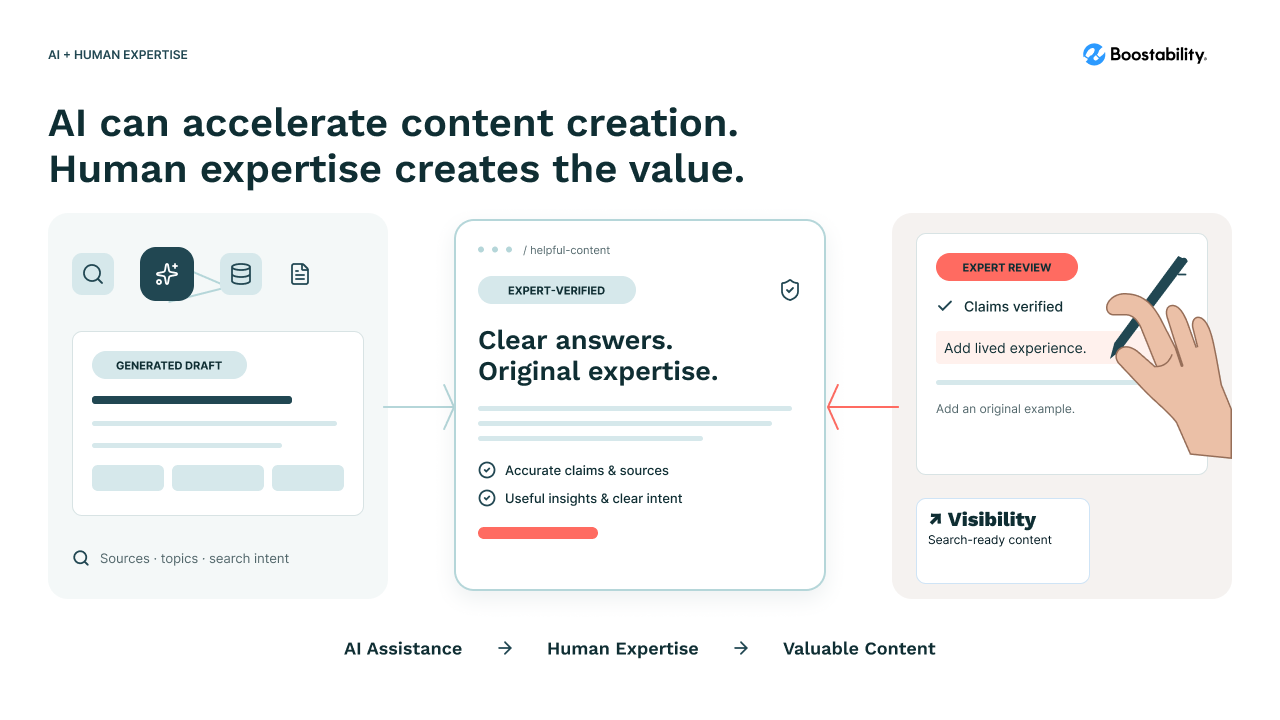
When AI tools first entered content workflows, their appeal was clear: tasks like brainstorming outlines and drafting copy became nearly instantaneous. Today, AI has fundamentally changed how businesses handle research, metadata generation, and content creation.
As AI-assisted publishing becomes more accessible, business owners and digital marketers face a key question: Does Google care if you create content with AI?
Google’s latest Search Quality and Spam guidelines provide a clear answer.
The primary concern isn’t how you create content, but what you publish, why you created it, and whether it provides genuine value to readers. For searchers, this means accessing trustworthy information. For Google, it means search results must keep meeting user intent.
For businesses leveraging AI in digital marketing, understanding this distinction is essential for sustaining long-term search visibility.
Google Isn’t Saying “Don’t Use AI”
A common misconception in digital marketing is that using generative AI will automatically result in a site penalty.
That’s not what Google’s documentation says.
Google explicitly permits generative AI for research, idea organization, outline creation, and drafting support. Rather than penalizing AI use, Google assesses the quality, effort, and intent of the final page.
AI should enhance your content workflow, but it should not replace subject matter expertise, professional judgment, or brand originality. When reviewing your pages, consider the core question from Google’s people-first framework:
“Would this page still deserve to exist if search engine rankings didn’t exist?”
If the answer is no, the page requires additional human insight.
The Core Risk: Scaling Content Without Scaling Value
AI significantly reduces content production costs. However, producing numerous near-identical articles for similar keywords or locations does not inherently increase value.
Google explicitly defines Scaled Content Abuse as producing large volumes of pages primarily to manipulate search rankings rather than help users.
The Local & Long-Tail SEO Trap
Consider a home services business serving multiple cities. AI makes it simple to generate programmatic pages like:
- Plumbing Services in City A
- Plumbing Services in City B
- Plumbing Services in City C
If these pages only change location names while keeping the text identical, they constitute scaled content abuse.
In contrast, high-value local pages integrate AI drafting with authentic local elements such as customer testimonials, project highlights, neighborhood-specific FAQs, and local media. While AI can support the process, human experience delivers the true value.
The 4 Pillars of Search Quality: Effort, Originality, Skill, and Accuracy
Google’s updated quality evaluator guidelines point directly toward four essential characteristics for main content:
| Effort | Meaningful work, research, or curation behind the page. | Hands-on testing, original interviews, and custom analysis. |
| Originality | Perspectives or findings not simply scraped or repeated. | Unique client data, proprietary frameworks, and first-hand stories. |
| Skill & Talent | Demonstrated authority needed to answer the query. | Subject matter expert (SME) reviews and editorial oversight. |
| Accuracy | Factually reliable, verified information. | Fact-checking statistics, quotes, technical details, and metadata. |
Why AI Metadata and Structured Data Require Human Oversight
AI adoption extends beyond body copy. Many teams use AI to generate meta descriptions, page titles, image alt text, and JSON-LD structured data.
However, AI-generated errors can appear in code and metadata as readily as in prose. Automated tools may produce syntactically correct schema with inaccurate addresses, outdated pricing, or incorrect business categories.
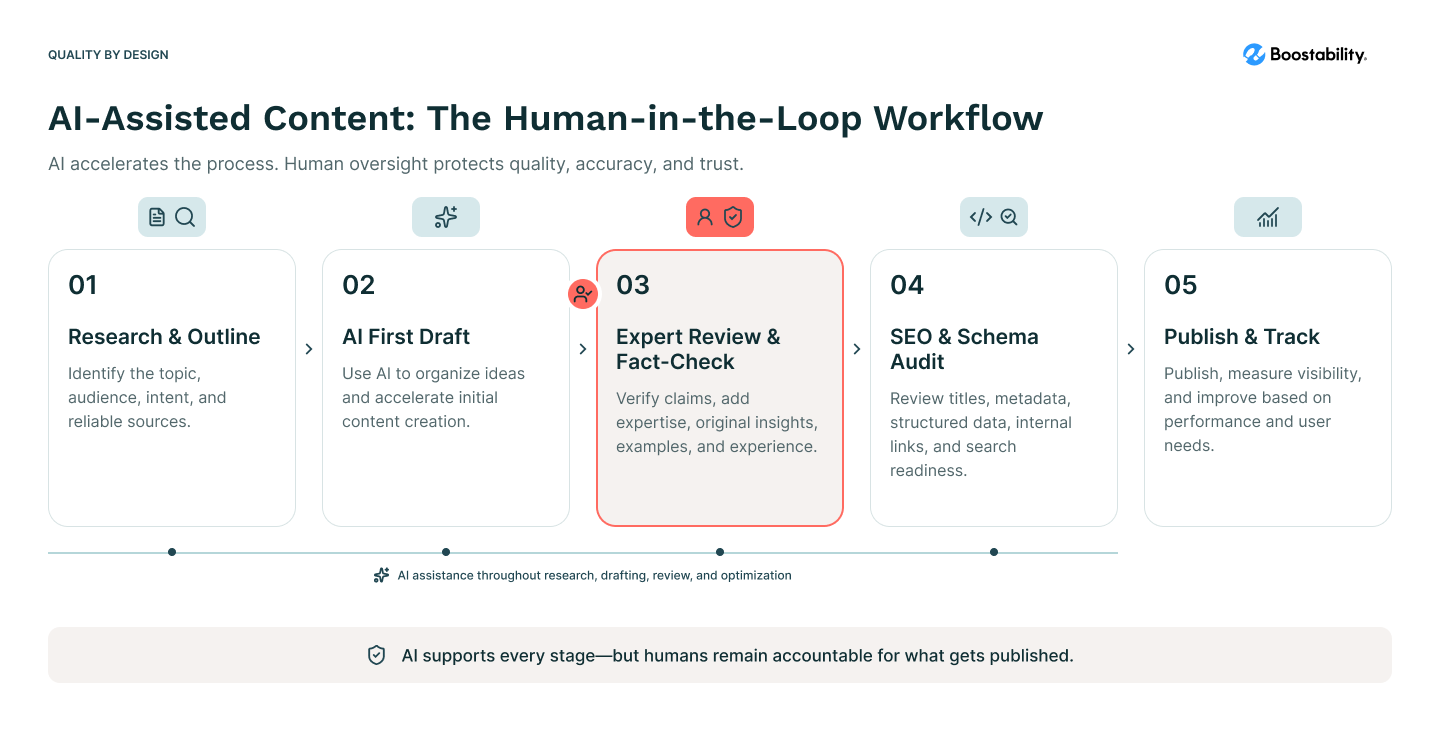
A robust AI-assisted publishing workflow requires thorough human oversight at key checkpoints:
Research⟶AI Drafting⟶Expert Insight⟶Fact-Checking & Editing⟶SEO & Schema Validation⟶Publication
Connecting the Dots: Navigating AI Search with the Be Found Framework™ (BFF)
Google’s guidance reflects a broader shift in search engine architecture. As AI-driven search experiences and conversational agents become more prominent, traditional keyword targeting is no longer sufficient.
At Boostability, we address modern search visibility with our Be Found Framework (BFF), a holistic strategy that keeps your business visible, trusted, and actionable across all search environments:
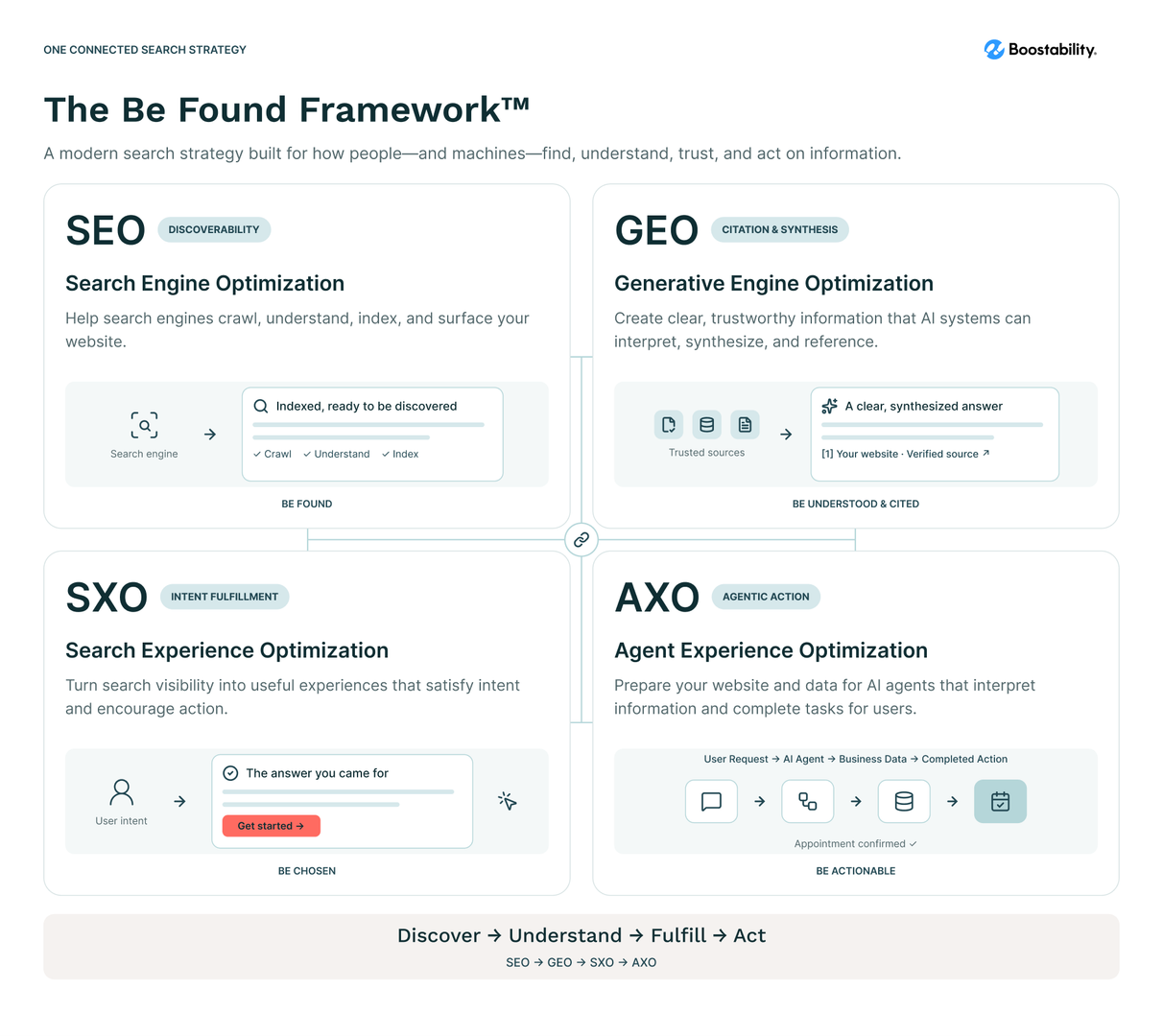
- SEO (Search Engine Optimization) — Discoverability: Ensuring search engines can crawl, index, and properly interpret your underlying site structure.
- GEO (Generative Engine Optimization) — Citation & Synthesis: Structuring authoritative, verifiable content so AI models cite your business as a primary source.
- SXO (Search Experience Optimization) — Intent Fulfillment: Creating intuitive, engaging user experiences that satisfy the searcher’s objective immediately upon arrival.
- AXO (Agentic Experience Optimization) — Actionability: Preparing your website data so emerging AI agents can seamlessly interact with your business to complete transactions or schedule appointments.
A Practical AI Pre-Publishing Checklist
Before publishing any AI-assisted draft, review it using this Boostability quality audit:
[ ] Fact Verification: Have all statistics, names, quotes, and claims been independently verified by a human?
[ ] Originality Add: Does the piece include proprietary insights, customer data, or first-hand experiences AI couldn’t replicate?
[ ] Expert Oversight: Has a subject matter expert reviewed the copy for nuance and industry accuracy?
[ ] Metadata Audit: Are schema markup, page titles, and alt text verified for complete accuracy?
[ ] User Intent: Does this page exist to help a real person solve a real problem, or was it built solely for search engines?
The Bottom Line
Generative AI streamlines processes, but it does not replace expertise. As AI-generated content becomes more prevalent, the value of trust, originality, and authentic human experience continues to rise.
The businesses that lead the next era of search will not necessarily publish the most content. Instead, they will provide search engines and users with the strongest reasons to trust them.
Ready to Modernize Your Search Strategy?
Discover how Boostability’s Be Found Framework (BFF) can help your business achieve maximum visibility across search engines, AI overviews, and conversational search platforms. See SEO & AI Readiness Audit Today